
Pigs have a lot in common with humans — including their anatomy, organ structure, genetics, physiology and immune function — and have been increasingly used in biomedical research. The similarities between pigs and humans make them strong models for both basic and clinical research.
There is a growing appreciation among the biomedical community of the value that pigs bring to research. Pigs are increasingly recognised as one of the most relevant non-primate models for translational medicine. Humans have also lived and worked with pigs for centuries, so their welfare needs are well understood.
Over the last decade, researchers and clinicians have increasingly seen how useful pigs are in many areas of biomedical study — for example, by providing organs for vital human transplants, improving our understanding of diseases such as cancer and heart failure, and serving as models for surgical training.
Pigs have a lot in common with humans — including their anatomy, organ structure, genetics, physiology, and immune function — so using pigs in research studies can predict similar results in humans, compared to other large animals or the most common research mammal, the mouse. The numerous similarities between pigs and humans make them strong models for both basic and clinical research.
Pigs have played an important role for studying congenital diseases, heart diseases, immune response, development of new vaccines and xenotransplantation — organ transplantation from animals to humans. In some cases, pigs are also important to make sure that drugs are safe and to assess if they have potential to treat health conditions.
In this article, we explore areas of biomedical research in which pigs play an important role, how pigs are used in research, their limitations as a model, how the pigs are housed and cared for and advancements and current research to improve welfare of pigs in research.
Pigs make better medical research subjects than [humanised] mice, because they are closer to humans in size, physiology and genetic makeup.
Dr Adeline Boettcher, Iowa State University, USA
Why are pigs used in research?
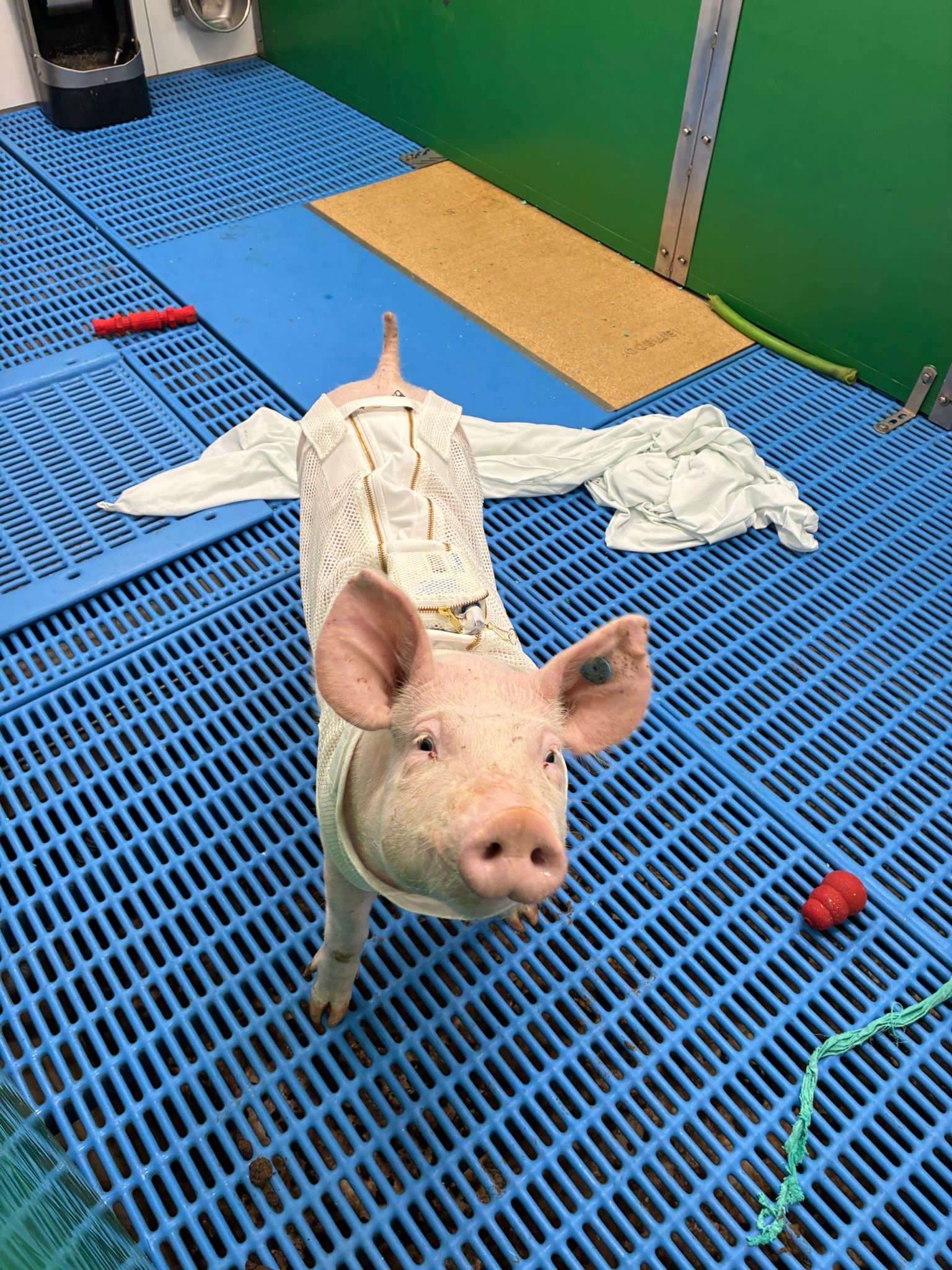
Pig with a non-invasive device, covered by a jacket, for recording ECG avoiding daily manipulations. CREDIT: CREBA, IRBLleida, Lleida, Spain
Modern gene editing technologies mean that pigs can be genetically altered to introduce, delete or alter specific genes to mimic more closely the human body. Since researchers have been able to map the pig genome, the availability of information about their genes and how they compare to humans meant that scientists could make more discoveries in medicine and basic research using pigs.
Pigs have a relatively long lifespan, allowing long-term disease studies, and their body size enables use of standard human clinical instruments. They are also easier to handle and breed than primates, making them a practical and ethically preferable large-animal model.
Biomedical research is also increasingly making use of a specially bred type of pig called a minipig. The smaller size of these pigs, compared to larger farm pigs, makes them easier to manage in a lab setting, while possessing more fitting characteristics for research, such as their genetics and temperament. One of the most common breeds of minipig used in Europe, especially in pharmaceutical research, is the Göttingen minipig, derived from the crossing of three different breeds. The largest supplier is EARA member Ellegaard Göttingen Minipigs.
Which areas of research use pigs
Due to the many similarities shared between the pig and human body – from the teeth and skeleton to organ and blood systems – pigs are one of the standard animals used to train surgeons in often crucial and complicated procedures.
In combination with technology such as simulated training environments and robotics, animals can allow for best performance and practices in surgery, while moving away from training on human patients altogether. This invaluable training is carried out by organisations such as EARA member Orsi Academy, Belgium, where pigs are put under anaesthetic with a team of animal caretakers and veterinarians to ensure that their welfare and ethical needs are being addressed and met.
How are pigs taken care of?
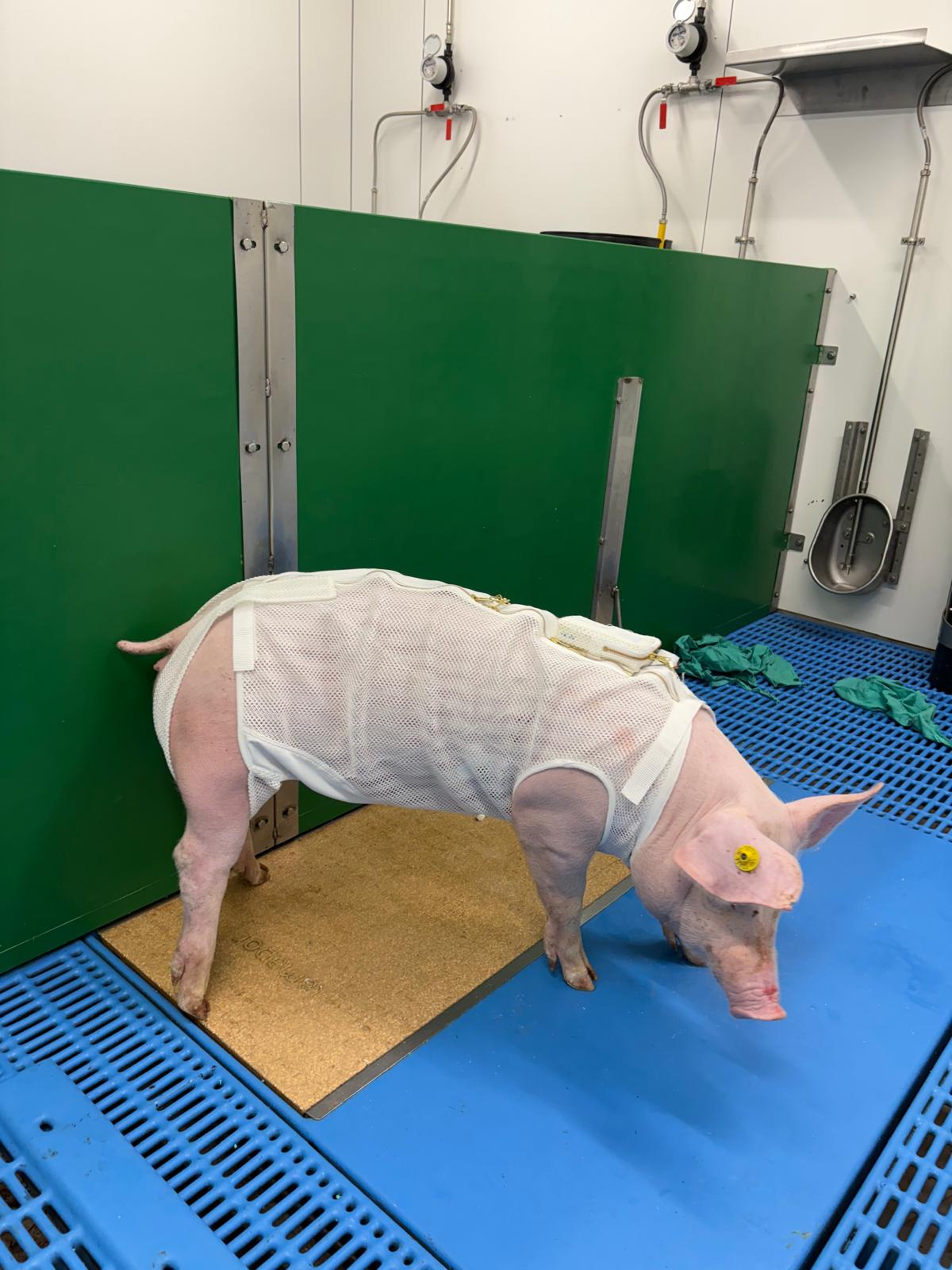
Pig with a non-invasive device, covered by a jacket, for recording ECG avoiding daily manipulations. CREDIT: CREBA, IRBLleida, Lleida, Spain
In research facilities, pigs are kept in spacious pens with social groups that reflect their natural behaviours — around 0.5 m² per minipig and 1.35 m² per full-grown pig — with non-slip flooring and clean bedding such as straw or sawdust that supports natural behaviours like burrowing and nesting. They are regularly monitored by animal care staff and veterinarians, while environmental controls maintain comfortable temperatures, lighting and hygiene.
Pigs are omnivorous and naturally prefer sweet-tasting food; in research settings, they receive age-appropriate pelleted diets formulated to meet their nutritional needs. Because pigs are highly social animals, they are kept in stable groups with clear hierarchies, and single housing is only permitted for medical reasons while maintaining visual and auditory contact with companions.
To support mental stimulation, chains, balls and feeding toys encourage exploration, while training and habituation help pigs cooperate calmly during handling or procedures — reducing stress and improving both animal welfare and research quality.
Limitations of pigs as animal models for biomedical research
Despite the close anatomical and physiological similarities between pigs and humans, important differences remain to be considered. For instance, pigs have six liver lobes instead of four, and their placenta structure forms a more protective barrier between the mother and embryo, which can influence how substances are transferred during pregnancy. This is both a disadvantage, since the placenta is different from that of humans, and an advantage, since it allows human microbiota and proteins to be transferred to pigs after birthwithout ever having influence from their mothers. This way, pigs can mimic humans better when studying infection, immunity or even the effects of different diets.
Since the use of pigs in research has become more common in recent years, some areas of research still lack tools to use them. For example, in cognitive and behavioural research, even though pigs could be a promising model since they are intelligent and social, researchers are still developing the appropriate tests for assessing cognition and emotion.
Finally, practical challenges remain significant. Pigs require more housing space, resources and care compared to smaller animals such as fish, mice or rats, which makes research using pigs more expensive and time-consuming. Genetic tools and reagents are also more scarce compared with the ones available for research using rodents.
Replacement, reduction and refinement
For all live models we implement the 3R principle of Reduction, Refinement and Replacement as much as possible. Meaning that before any animal is used for a training or a research purpose, we make efforts to find a replacement alternative.
Marieke François, Veterinarian, Orsi Academy, Belgium
As with all species of animals used for research in Europe and elsewhere, the welfare of pigs is protected by law, and scientists must apply the 3Rs principles — Replacement, Reduction, and Refinement — to minimise pain, distress, and the number of animals used whenever possible.
In laboratory settings, pigs are handled using positive reinforcement training and gentle tools, such as swine boards or food rewards, which allow calmer restraint and easier blood collection. New, less invasive methods are also being introduced. For example, in EARA’s media bank you will find an example from CREBA, IRBLleida, showing how saliva sampling can now be used to detect stress and inflammatory markers in pigs, instead of taking blood samples.
During anaesthesia and recovery, refinements such as soft padding, dim lighting, quiet surroundings and dedicated post-operative care improve comfort and safety. Humane euthanasia is achieved using pre-medication and appropriate restraint methods to minimise distress. In surgical training, where pigs are commonly used, measures such as organ harvesting after procedures help reduce the need for additional animals in other training or educational settings.
Finally, pigs themselves are part of the replacement effort since they have been increasingly used in biomedical research as an alternative to non-human primates. For example, the NHPig project, founded by the EU, is a partnership between public and private organisations, led by LMU Munich, Germany, that seeks to identify where pigs could replace monkeys in safety testing.