Logo Eara
Any alternatives?

New approach methodologies

New approach methodologies (NAMs) are used in research as potential alternatives to animals and are progressively reducing and replacing animal use when feasible. Examples include human cell-based studies, which have been used in research since the early 1950s, and more cutting-edge methods such as patient-derived organoids, organ-on-a-chip and computer modelling. 
Various strategies, models, methods and technologies are employed in biomedical research, tailored to the specific nature of each research need, and animal models remain indispensable for many aspects of fundamental, translational and applied research. However, the investment in the development and implementation of NAMs, such as organ-chips, organoids and computational methods, offersresearchers the possibility to increasingly integrate complementary approaches alongside animal studies whenever feasible, contributing to more robust and reproducible study outcomes. 
In most research areas, scientists have to use diverse models to answer a specific scientific question. The choice of approach depends on the unique characteristics of the research in question and the best method, or methods, should be chosen in each case. 

Why are NAMs used in research? 

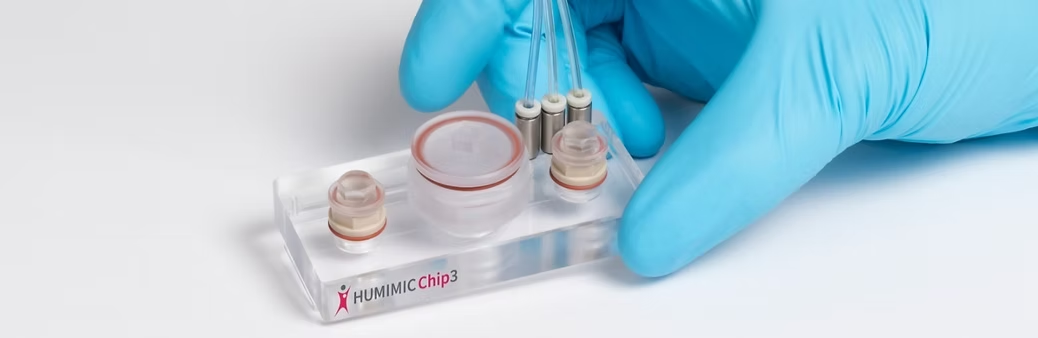
Multi-organ chip developed by TU Berlin and TissUse. CREDIT: TissUse GmbH
NAMs are increasingly used alongside animal studies to complement and sometimes replace animal experiments in research. Although NAMs lack the full systemic complexity of living organisms, they can answer specific or preliminary questions relevant to human biology. In fact, their simplicity in relation to animals and humans allows scientists to answer specific questions that are difficult to address in a living organism. Because NAMs can be derived from human cells, they can also more accurately reflect some human-specific biological responses, possibly including those that are poorly predicted by animal models. NAMs are also very promising tools for personalised medicine, once a patient’s own cells can be used to test their specific response to certain treatments.  
Since some NAMs have been developed recently, it’s necessary to establish common procedures for their implementation on a global scale, through education and training, and by establishing infrastructures needed for their use. Once specific NAMs are well established and validated, they are faster and cheaper than animal models, making it a suitable tool to apply in the clinical setting and to test personalised medicine approaches quick enough to inform medical decisions. 
While animal studies provide whole-body context, NAMs can offer greater experimental flexibility, both due to ethical constraints of animal research and because NAMs allow researchers to manipulate biological variables and analyse their results more easily, since they have direct access to the cells or tissues. Thus, the use of NAMs and animals in research is complementary. 
Are NAMs ready to replace all animal use in research?
As the research community continuously strives to replace, reduce and refine the use of animals (3Rs), NAMs are increasingly being developed.  
These approaches can currently address some areas of safety testing of new medicines and chemicals. However, NAMs can’t yet address all the fundamental/basic or translational research that leads to medical treatments and drug development, such as how whole, intact organs work and respond to therapies in a living body. For now, it is not possible to model systems and biological mechanisms that are poorly characterised and validated. For example, NAMs are not capable of modelling well biological systems such as the brain and interactions between multiple organs, which are complex and still lack understanding by the scientific community.  
In addition, regulatory provisions require the use of animal models for safety testing and this is enshrined in legislation, for drugs applied in both human and veterinary medicine. In the case of marketing authorisations for veterinary medicines, they require the use of animals to demonstrate safety and efficacy in the target animal population. 

Which types of NAMs are used in research? 

Whether human, animal or engineered, cells that are grown in the laboratory and maintained (described as cultured) outside a living organism, have been used within science for generations. The first human cell line was obtained in 1951, during the treatment of a patient with cancer, Henrietta Lacks. These cells, called HeLa, have contributed to many research advances. Cells of interest can be extracted from living tissue to be examined more closely under carefully controlled conditions, allowing researchers to understand how tissue grows, study specific mechanisms within the cells, test the effect of substances on cells, generate pharmaceuticals based on living cells and organisms, and much more. 
The fact that cells are grown in a very controlled environment offers advantages in terms of reproducibility and consistency, which allow for precise quantification and validation of scientific findings. Cells are also cost-effective and a way to study human or animal health without ethical constraints. 
When it comes to regulatory testing, lab-based (in vitro) methods are already well-established and validated in assessing certain types of toxicity, such as for the skin, to test sensitivity and irritation. Here, different compounds that are found in common products, that may trigger an allergic reaction for instance, can be used to cause such a reaction in human tissue models, to understand the effect it will have. 
However, there are some key limitations of using in vitro, the major one being tied to the very nature of these techniques, as cells in a dish are unlikely to behave in exactly the same way as in a living organism or their natural environment. Cells are also grown flat in a dish, whereas in the body they are surrounded by other cells in a 3D arrangement, and they interact with their environment, engaging in complex communication with their surroundings and other cells and tissues. 

In which research areas are NAMs more widely used? 

NAMs are also used for greater scientific understanding (basic research) and translating basic research to develop new drugs and treatments. Through a combination of techniques and information, gleaned from both animal and non-animal studies, researchers can build the best possible understanding. 
NAMs are limited in the complexity of information they can provide about the living body, but often they can model more faithfully certain aspects of some isolated human biological systems, closed mechanisms and predict interactions, helping to improve the translation of research findings from the lab to the clinic.  
Artificial intelligence can simulate some biological processes or even how certain diseases progress, leading to the identification of possible drug compounds, as well as predictions about how they might behave once in the body. A study led by the Spanish National Research Council trained an AI system to detect brainwaves in monkeys that are disrupted in neurological disorders such as Alzheimer’s, based on brain recordings from mice. Without artificial intelligence these brainwaves could otherwise be missed by standard imaging techniques, contributing to the improvement of the diagnosis of brain diseases.  
Meanwhile, cells grown in the lab – from human cells to more complex organoids and organs-on-chips – have been developed for a range of different diseases and conditions, including neurodegenerative diseases and cancer, and are showing promise for studying disease mechanisms, drug responses and developing personalised medicines – and in some cases reducing or replacing the use of animals.  
In a study at the University of Manchester, UK, researchers used lung organoids, produced from human stem cells, to investigate the possible effects of carbon-based nanomaterials on human health, with the results mirroring the negative effects on lung health shown in animal studies. Alternatives have also been used in basic research, such as in work at the University of Birmingham, also in the UK, that developed an organ-on-a-chip which replicated the blood vessels in the human liver, allowing scientists to understand how immune cells reach liver cells. 
NAMs, while they do not reach the full maturation of an organ inside a living organism, provide an important window into early developmental stages. By trying to replicate the development of an organ in a controlled, simpler system, scientists can pinpoint the steps involved in organ development and they can understand how certain substances affect it. Because these models are often human-based, they can capture mechanisms that are specific to humans. In 2025, researchers from IBEC, Spain, using a platform that mimicked the wall of an uterus, were able to capture the first video of a human embryo implantation, which could help improve understanding of the natural process and improve fertility and assisted reproduction techniques.  

Limitations of NAMs 

NAMs offer major advantages for human relevance and ethical research, but they also have important limitations.  
A main limitation of NAMs is their reduced biological and systemic complexity. Most NAMs model isolated cells, tissues, or a limited number of interacting organs, which means they cannot yet fully replicate whole-organ and whole-body processes. As a result, complex interactions involving multiple organs are difficult to capture in these models, particularly for chronic, systemic conditions and to study particularly complex systems such as the immune system or the brain. 
In neuroscience, for example, even though brain organoids are important tools to study brain development, model aspects of disease and test drugs, they are very far from mimicking key brain functions. Organoids lack complex circuits between neurons and, although they can generate neural oscillations, it’s uncertain if they could ever acquire consciousness. This possibility has also prompted an ethical discussion about the future of brain organoids. Besides questions of ownership and commercialisation, which are centred on the origin of the cells used to grow the brain organoids, consciousness wouldentitle brain organoids with a form of moral status similar to those given to humans and animals participating in research. In addition, many NAMs are viable for a short period of time, making it difficult to study long-term processes. In part, their growth and durability has been limited due to the absence of blood vessels, with cells at the centre of organoids dying from lack of oxygen and nutrients. An important achievement in 2025 shows promise in this area, with researchers being able to generate the first organoids with their own blood vessels. But this has yet to be applied in other organoids. 
NAMs also face significant challenges regarding reproducibility due to the high inherent variability between different donors, and because working with human cells is more complex and less standardised. In the future, investing in standardisation, sharing protocols, and effective training could improve their reproducibility.   
Limitations in toxicology testing 
Despite the growing prevalence of NAMs, especially in the areas of toxicology and safety testing, there remain significant hurdles to getting these technologies to a place where they are widely established and accepted, from both a scientific and regulatory standpoint. 
In toxicity testing, there are concerns that NAMs cannot yet reliably assess complex health effects in humans. A 2022 article in Chemical & Engineering News highlighted the differing views of scientists about the question of using animals versus NAMs in chemical testing. Among the concerns raised about a phase-out of animals in this field, was that NAMs can sometimes capture unintended effects that are not the target, and cannot yet fully address more complex toxic effects, such as reproductive and developmental toxicology and carcinogenity, or effects that can arise due to long-term exposure and accumulation of a particular substance in the body from daily, repeated doses. 
For risk assessment of a new substance, it is necessary to make sure that all possible risks to people, animals and the environment are identified. Besides the general limitation that NAMs still can’t fully represent biological complexity, such as interactions between organs, the establishment of NAMs to analyse toxicology in any system needs to be carefully validated and legally approved. On a global scale, the establishment of common procedures to collect data obtained with NAMs is necessary to ensure that the same testing with maximal predictive capacity is carried out everywhere. For this, education and training, resources and infrastructures need to be available for their implementation.  
Consequently, there is still a lack of broad acceptance of these technologies by regulators, governing bodies and some parts of the scientific community. The growing investment will contribute to addressing these criteria and allow NAMs to enrich the ‘toolbox’ of methods at our disposal for carrying out regulatory science and managing harms and risks to both animals and humans. A wide range of strategies is certainly ideal, but jumping to conclusions prematurely, without a comprehensive scientific consensus and regulatory acceptance, carries significant risk, most importantly for human health further down the line. 
For the foreseeable future, it is likely that the complementary use of NAMs and animals will remain essential for testing. In addition, animals will always be required to develop veterinary medicine and so animal tests will always exist in order to understand the effect of drugs on animals specifically.
Useful sources 
Animal research is not always king: researchers should explore the alternativesNature 
European Medicines Agency on the regulatory acceptance of NAMs  
New Approach Methodologies – Where are we, what opportunities are we currently pursuing and what risks must we avoid?, Understanding Animal Research 
National Centre for the Replacement, Reduction & Refining of Animals in Research, NC3RS