
The 3Rs principles are central to European legislation on animal research: those who carry out animal research need to make every effort to replace, reduce and refine their animal research. Only projects that show that all three R’s have been taken into consideration, and the methods by which they will be implemented, will be granted a license.
Replace
To avoid the use of animals where they otherwise would have been used, by using other methods capable of answering the same questions.
Reduce
To minimise the number of animals used while still obtaining reliable and robust results via increased data collection and better experimental design or statistics.
Refine
Minimising the pain, suffering, distress or lasting harm that the animals experience by modifying procedures and using the most up-to-date techniques.
The 3Rs are typically presented in the same order: replacement, reduction and refinement. This order indicates the order in which they are to be applied to animal research. First, determine whether the animal study can be replaced by alternative methods. If this is not possible, try to reduce the number of animals used as much as possible while still generating reliable results and lastly, take all necessary measures to reduce the burden on the animals in the study.
The order of the 3Rs does not indicate any hierarchy, meaning all three Rs are of equal importance and should all be given equal attention.
When were the 3Rs introduced in research?
The 3Rs were first described in 1959 by William Russell and Rex Burch in their book, The Principles of Humane Experimental Technique. The main idea behind the book was that improved science and improved animal welfare go hand in hand. In 1986, the 3Rs principles were formally incorporated into EU law with Directive 86/609/EEC, though enforcement mechanisms at that time were not harmonised across EU Member States. Under the current EU Directive 2010/63, the 3Rs are legally binding across all Member States and are centrally integrated in EU law and enforcement.
Replacement in animal research
Replacement means that researchers are to use alternative methods wherever scientifically possible. This can mean complete replacement by not using any animals at all. It can also mean partial replacement, which means you replace the animals for animals of a different species that have a lower capacity for experiencing pain, distress or harm.
This is why it is the first R in the order: ‘replacement’ questions and critically assesses the necessity of the study and the animal use.
If a study can be performed equally well with mice compared to rats, the researchers are obliged to work with mice as they are the cognitively lower species, less capable of experiencing pain and suffering compared to rats. For example, researchers from the University of Exeter have performed gene-editing in wax moths, opening avenues to use them as a replacement for rodents in some types of research, particularly infection. Wax moths are susceptible to similar bacteria and fungal infections as humans, and their cells also respond in a similar way. Yet, their use as a model organism in research has been limited by the lack of genetic tools. Another example is the NHPig project which is a five-year partnership of organisations that investigate where micro- and minipigs could be used in place of monkeys to assess the safety of potential therapies.
Ideally, animal experiments are fully replaced by methods that do not involve (live) animals. In certain research areas, there has been great progress in replacing animal experiments, while in others, much less so for the moment. Some areas, such as immunology and neuroscience, require whole-organism responses, as all organs in the body are affected by biological processes or a certain disease being studied.
Cell culture systems, stem cell technology, tissue culturing, tissue engineering and computer models are advancing technologies that are becoming more complex. Often used in combination or complementation, they are increasingly used to replace some animal experiments, especially for research questions regarding molecular and cellular mechanisms and simpler endpoints, such as skin irritation. Examples of animal-free models in this area include a synthetic gel that behaves like skin in development by Dutch, Belgian and Chinese researchers and the first 3D model of human lips developed by researchers in Switzerland. See more in our new approach methodologies feature.
Reduction in animal research
Reduction means that researchers use fewer animals to obtain the same amount of scientifically valid information. Balance in achieving the appropriate number of animals to be used is essential, as it is important that results remain robust and valid. After all, underpowered studies using too few animals to be able draw solid conclusions would essentially be a waste of animal lives too and would not pass the harm-benefit analysis required for each project evaluation.
Depending on the study, there are different ways for researchers to make animal use more effective. With smart experimental designs and statistical analyses, researchers can find the optimal number of animals to use that give sufficient statistical power. Using shared control groups across multiple studies is in development in regulatory testing to decrease the number of animals deemed necessary. Also, improving how the animals model a certain disease or process, e.g. through genetical alteration or diet, can potentially reduce variability in data and thereby reduce the minimum number of animals needed.
Technological improvements can also contribute to reduction, for example imaging techniques such as MRI or PET imaging. These techniques allow for multiple measurements in the same animal overtime and the more advanced these measurements become, the less need there is for more invasive studies where different animals are euthanised at different timepoints. Another example of how technological progress can lead to reduction is the use of so-called ‘Flycodes’, small protein fragments that can be used to tag and trace antibodies that are tested for therapy in mice. Being able to trace different antibody treatments means that multiple treatments can be tested in one mouse whereas before only one treatment could be tested in one mouse.
Biobanks are another way to reduce the number of animals used. Biological material such as tissues, organs, blood or DNA can be stored so they can be reused for future research or shared with other labs. It maximises the use value of each animal.
Refinement in animal research
Refinement means that researchers and animal facility staff modify procedures, care and housing so that they improve animal welfare and limit pain, suffering, distressand harm. This is of benefit of the animals that are still included in studies after efforts to replace and reduce their use but is usually also of benefit of the quality of the research. This is because high stress levels can negatively impact research results, even if a study does not focus on stress or the stress response specifically. An example of a modified procedure that is non-invasive is saliva sampling. Researchers at the Centre de Recerca Experimental Biomèdica Aplicada in Lleide, Spain measure stress or inflammatory markers in pigs from their saliva instead of taking a blood sample. Similarly, but in fish, UK researchers found that skin swabbing is an alternative to collecting DNA where the usual procedure is fin clipping.
The higher the estimated severity level of a procedure is, the more measures need to be taken to mitigate pain and distress. This concerns much more than only analgesia and anaesthesia during painful procedures. There are numerous ways researchers and animal care staff can make animals feel more comfortable during procedures, such as habituating the animals to the researcher handling them or to equipment. For some procedures, animals can also be trained to cooperatevoluntarily, which gives them a feeling of control and makes the handling less stressful. In addition, handling techniques or procedures themselves may be modified to make them less harmful or stressful to the animals, for example cupping a mouse instead of lifting it by its tail.
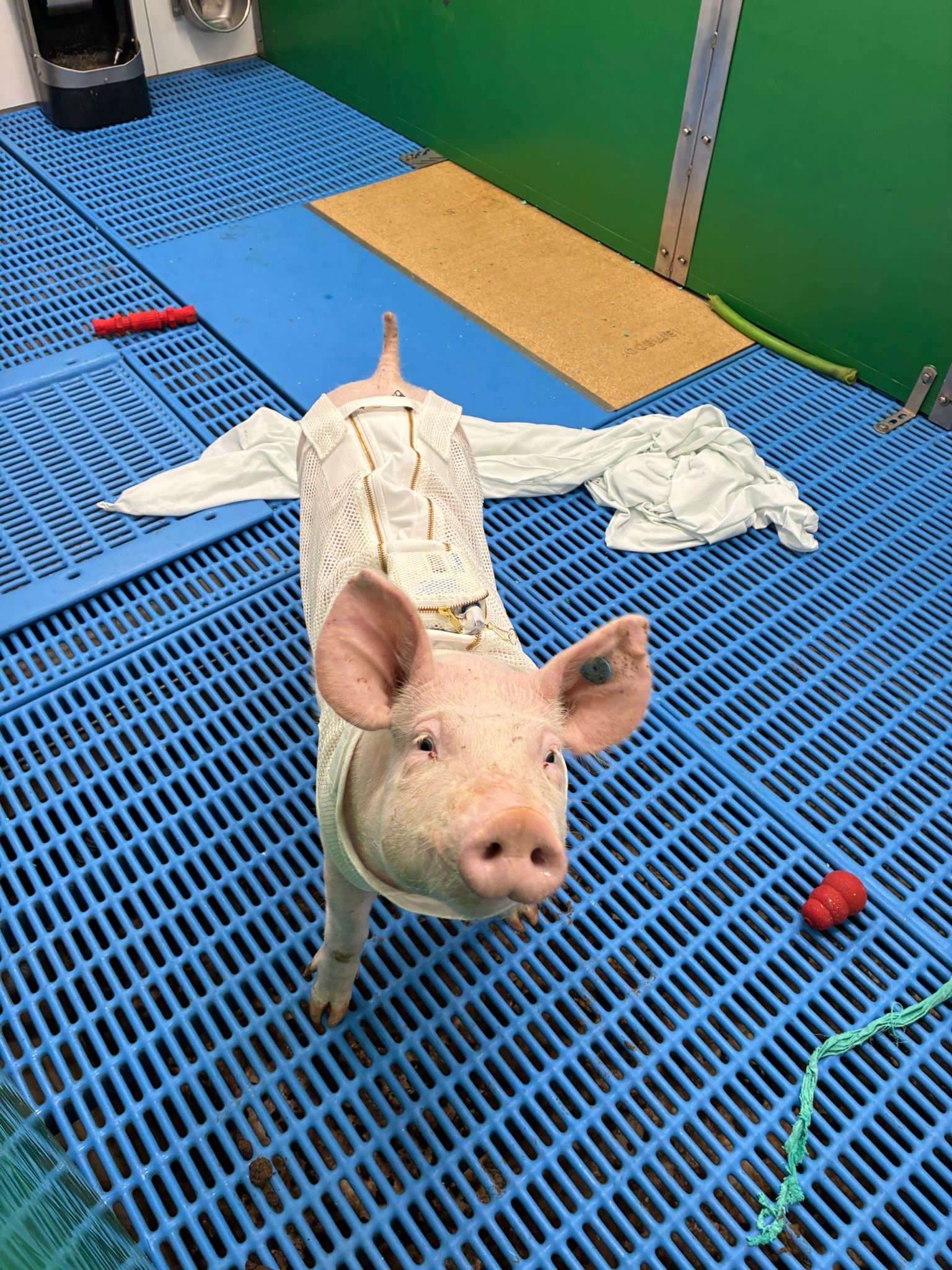
Pig with a non-invasive device, covered by a jacket, for recording ECG avoiding daily manipulations.
Also, the animals’ housing conditions play an important role in their welfare, as they are likely to spend most of their time there. Here, refinement is about lowering stress and fear levels and allowing for the animals’ natural behaviour as much as possible. Many refinement measures are obligatory under the Directive, such as social housing for social animals, environmental enrichment such as appropriate bedding and nesting materials, hiding places and objects to explore and play with, but also minimum cage or enclosure measurements. Animal facilities control the light-dark cycle for a healthy circadian rhythm and limit sounds and smells (wearing perfume in the animal facilities is not allowed) to prevent stress. The health status of animals over time throughout the study is also taken into account and adjusted to. For example, if after a surgery a mouse will not be able to reach up to the food rack, researchers and caretakers will provide wet food in the bottom of the cage which the mouse can easily access.
Harm-benefit analysis
The harm-benefit analysis is a structured evaluation part of applications for project licenses under EU Directive 2010/63. It looks at whether expected scientific, educational or societal benefits of a proposed study justify the expected harms inflicted on the animals. This includes all potential harms, such as pain, suffering, distress, or lasting harm and takes into account severity, duration and the number of animals affected, as well as all likely benefits, including the importance, relevanceand probability of achieving the stated objects. In addition, the analysis must show that the harms are minimised through application of the 3Rs.
Each of the 3Rs are translated into decision rules of the EU Directive 2010/63. Researchers have to take them into account throughout the application process for their project licenses:
Replace – The Directive requires proof that there is no scientifically satisfactory animal-free method available and that alternatives were actively searched for and assessed.
Reduce – Researchers have to show and justify that the number of animals used in each project is the minimum needed. The experimental design needs to be detailed and statistically robust to obtain meaningful results.
Refine – In addition to the harm-benefit analysis where the potential harm is weighted against the potential gains of the study, there are also severity limits that can never be exceeded. Analgesia and anaesthesia are obligatory. The Directive describes detailed housing standards for each species and researchers must have a predefined plan in case certain severity levels are exceeded during the study, so-called humane endpoints.
Other useful sources
The Principles of Humane Experimental Technique by William Russell and Rex Burch (1959)
The Three Rs and the Humanity Criterion (updated version of the original book by Russell and Burch)