
The European Animal Research Association (EARA) and Otto von Guericke University Magdeburg (OVGU) held an Openness Event in Magdeburg, Germany, on 6 October, bringing together around 50 researchers and other professionals to discuss how institutions can communicate more openly and effectively about animal research in Germany.
Held at OVGU, the meeting explored how greater openness can help research institutions explain why and how animals are used, how different experimental approaches are selected and combined, how animal welfare and the 3Rs are incorporated into research, and how researchers can engage more confidently with patients, the public, policymakers and the media.
The event opened with a powerful welcome address from Daniela Dieterich, Dean of the Medical Faculty. "Silence is not a strategy," she said, adding that there is a need for "openness about science itself: which questions cannot be answered in any other way at present and which alternatives we already use.”
Kirk Leech (EARA) opened the presentations by discussing why researchers and institutions need to stay proactive about animal research communication, especially as political moves to phase out animal research in several countries risk undermining Europe's research capacity. He argued that greater transparency is essential to improving public understanding and to ensuring that discussions about animal research are informed by researchers themselves.
Sabine Brandt (OVGU) presented her kidney research, showing how animal experiments and animal-free approaches can work together to answer different scientific questions. "There is no single perfect model of kidney disease," she said, advocating the use of in vitro, in silico and in vivo models and patient samples for better science. Markus Fendt (OVGU) presented the development and use of voluntary touchscreen experiments in neuroscience, showing how changes to experimental approaches can improve both animal welfare and the reliability of scientific data.
Kristine Krug (OVGU) focused on openness in research involving non-human primates, discussing why these animals are used to address particular questions in neuroscience and the importance of explaining this research clearly to the public. Drawing on her work with high school students, she noted that their first questions were about the science, and only afterwards about the choice of animal model.
Nuno Gonçalves (EARA) introduced the Patient Discovery Project, which connects patients and organisations with researchers using animal models. He emphasised that early, two-way dialogue with basic researchers - not just at later clinical phases - is essential for integrating patient perspectives into research decisions affecting quality of life.
The presentations were followed by a panel discussion with all speakers and Franziska Scharkowski (OVGU), who runs PROTRAT, a project funded by the state of Saxony-Anhalt to improve processes around animal research. The project supports networking among animal research and welfare professionals in the state and beyond, identifies and introduces new processes to reduce bureaucracy, offers legal advice and supports public communication.
The moderated panel explored how openness relates not only to communicating research results but also to explaining how research decisions are made, from choosing appropriate modelsand applying the 3Rs to navigating institutional and regulatory processes.
Other issues raised with participants included concern that Refinement is increasingly becoming the forgotten R of the 3Rs, and the need to communicate new approach methodologies (NAMs) and animal studies together. The recent Stanford study, in which human brain organoids were grafted into mice, was cited as an example of how blurred the line between the two can be. Participants also discussed the risk of continuing to let animal activist groups define the public image of animal research, and the lack of time, staff and institutional support that keeps scientists from taking a more active part in these discussions.
EARA will continue working with OVGU, Tierversuche verstehen (TVV) and research organisations across Germany to support greater openness, encourage researchers to communicate about their work and strengthen constructive public discussion about animal research and alternative approaches.
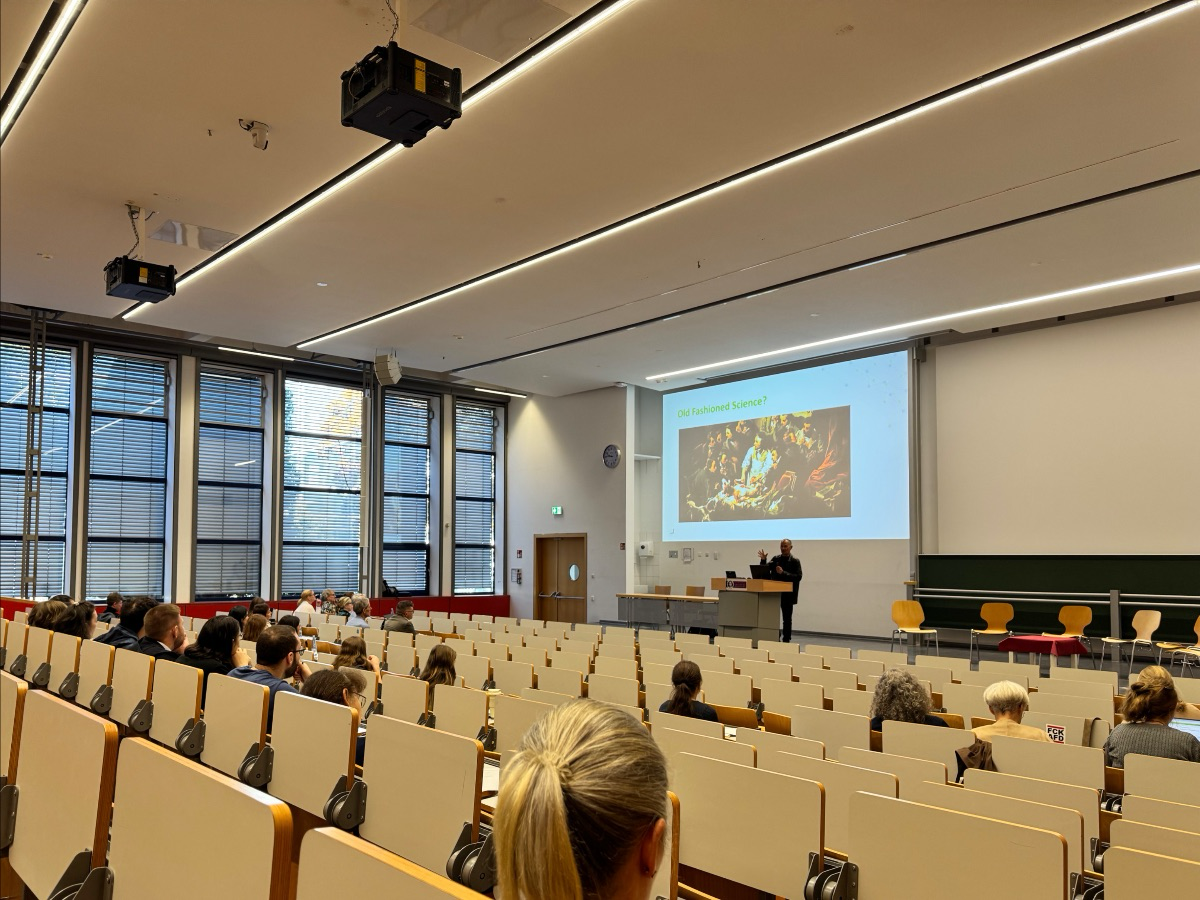
Kirk Leech at Otto von Guericke University Magdeburg (OVGU), Magdeburg, Germany.