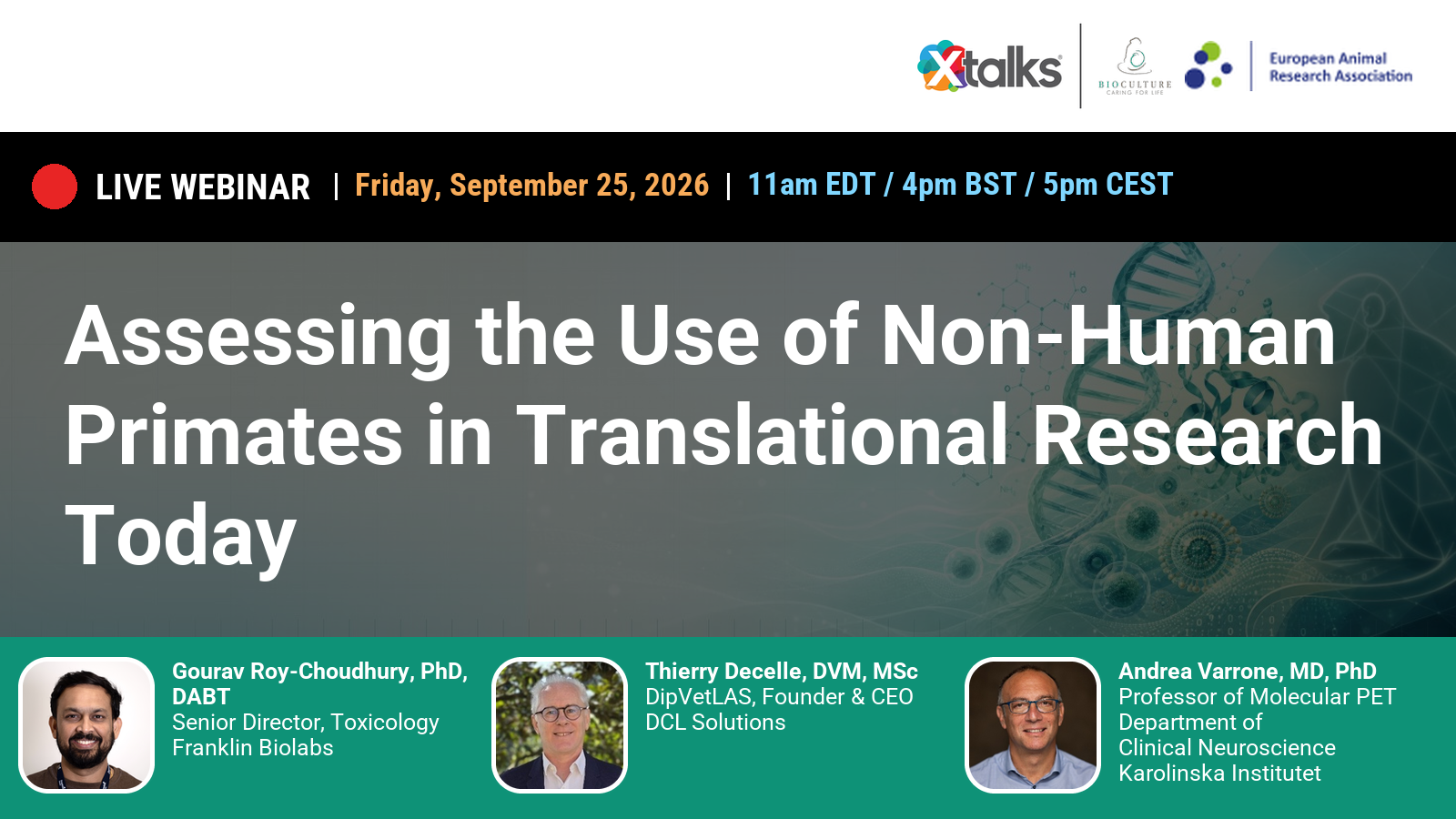
The Bioculture Group and EARA have partnered with Xtalks – The Life Science Community™ to launch a four-part webinar series on the science, regulation and responsible use of non-human primates (NHPs) in biomedical research.
The first session, held on 25 September, explored how NHP studies have contributed to medical progress and how they can inform clinical research. Speakers also discussed how NHP research fits alongside emerging alternatives and the importance of choosing animal models based on clear scientific reasons.
Thierry Decelle from DCL Solutions gave an overview of the historical contributions of NHPs to biomedical research. Gourav Roy-Choudhury from Franklin Biolabs discussed how animal studies and new approach methodologies (NAMs) work together to assess the safety of advanced therapies, including gene therapies and RNA vaccines. He highlighted the importance of selecting the right species and methods for each therapy and safety question, and of combining evidence from different approaches.
Andrea Varrone, from EARA member Karolinska Institutet, presented examples from neuroscience, including the development of a tracer used in brain scans that, after more than a decade of research in animals, including cynomolgus monkeys, is now used in clinical practice to support the diagnosis and prognosis of Parkinson’s disease. He also described how NHP studies allowed researchers to select a formulation of the drug osimertinib which could reach the brain to treat brain tumours.
Speakers highlighted the need for scientifically justified NHP research, combined evidence from different methods and continued application of the 3Rs—Replacement, Reduction and Refinement. The next webinar, on 14 December, will explore NHP research in diseases that need urgent solutions.
The recording of the first session is available on the Xtalks platform.