
A study from Austria and Hungary discovered that dogs’ brains can tell human emotions apart, such as happiness, anger, sadness and fear, from facial expressions, suggesting that domestication shaped dogs’ social abilities.
Researchers from the University of Vienna, Austria, and EARA member Eötvös Loránd University, Hungary, trained twelve pet dogs to be awake during magnetic resonance and registered their brain activity while seeing pictures of unfamiliar humans showing happiness, neutral expressions and a range of negative emotions, namely anger, fear and sadness.
The team found that facial expressions of happiness have the strongest effect on dogs, activating regions of the brain associated with complex mentalprocesses and reward. The researchers also discovered that different negative emotions elicited different patterns in dogs’ brain activity. Dogs clearly distinguish human expressions of fear from sadness and anger, but do not distinguish well between sadness and anger, showing that fear is the negative emotion more prominently understood.
"They [dogs] have evolved with us to understand our expressions and cooperate with us, and recognizing that can change how we communicate with and care for them," said Laura Cuaya, leader of the study published in iScience and researcher at the University of Vienna and Eötvös Loránd.
Future research will have a more dog-centred approach by focusing on how dogs combine signals to try to understand people around them.
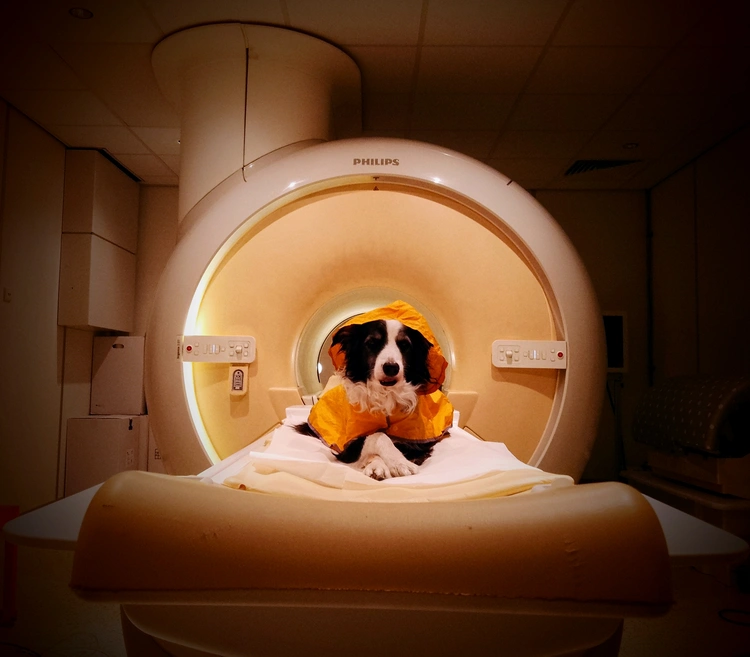
Kun-kun sitting at the magnetic resonance machine. CREDIT: Laura Cuaya.