
The 2026 Nobel Prize in Physiology or Medicine has been awarded to Karl Deisseroth, Peter Hegemann and Georg Nagel for discoveries leading to the development of optogenetics, a technique that makes it possible to switch individual neurones in a living brain on or off using light.
For decades, researchers relied mostly on anatomical data and correlations to understand how the brain works, because they had no way to control the extremely fast activity of neurones. In the 1990s, Peter Hegemann, working at the Max Planck Institute for Biochemistry, Germany, studied how the single-celled alga Chlamydomonas swims rapidly towards light and tried to isolate the proteins responsible. However, once removed from the cell, the proteins proved unstable and difficult to study.
When the genome of Chlamydomonas was sequenced, Hegemann found two genes resembling those of known light-sensitive microbial proteins and contacted Georg Nagel, at the Max Planck Institute for Biophysics, who was experienced in producing proteins in frog egg cells, to produce them.
They discovered that these proteins, channelrhodopsin-1 and channelrhodopsin-2, are channels in the cell membrane that open in response to light, letting in positively charged ions that generate electrical signals. They then focused on channelrhodopsin-2, which responds to light in only 0.2 milliseconds, and genetically modified human and hamster kidney cells to produce it, making the cells light-sensitive. These discoveries set the stage for psychiatrist and bioengineer Karl Deisseroth, at the Howard Hughes Medical Institute and Stanford University, US, to introduce the protein into the brain.
Deisseroth, who wanted to control the activity of neurones in a living brain to study disease, introduced channelrhodopsin-2 into rat neurones grown in Petri dishes. The protein did not disrupt their normal function, and the cells generated and propagated nerve signals when exposed to light. In 2007, Deisseroth’s lab activated neurones in living mice, controlling the animal’s whisker movements by illuminating neurones in the motor cortex with a thin optical fibre inserted through a small hole in the skull.
“Optogenetics is an engine for discovery,” Deisseroth told Stanford Report. “We want to understand how the brain works as an intact system to carry out complex cognitions, behaviors, and perceptions while being anchored and grounded in the elemental cellular level. […] Once you know the cells that are important in a symptom or in correcting a symptom, then you can design any method you like to target their activity.”
Since then, optogenetics has transformed our understanding of the brain, revealing which circuits control memory formation, pain, social behaviours, thirst, food consumption, reward and attention. It has also shown how the brain interacts with the body – for example, how it controls fever, and how a faster heartbeat can drive anxiety.
“By studying animals we can learn […] how our normal healthy brain works but also to understand what happens when it doesn't work properly, when we have different diseases affecting the brain,” said Anna Wedell, genetics professor at EARA member the Karolinska Institutet and member of the Nobel Committee for Physiology or Medicine.
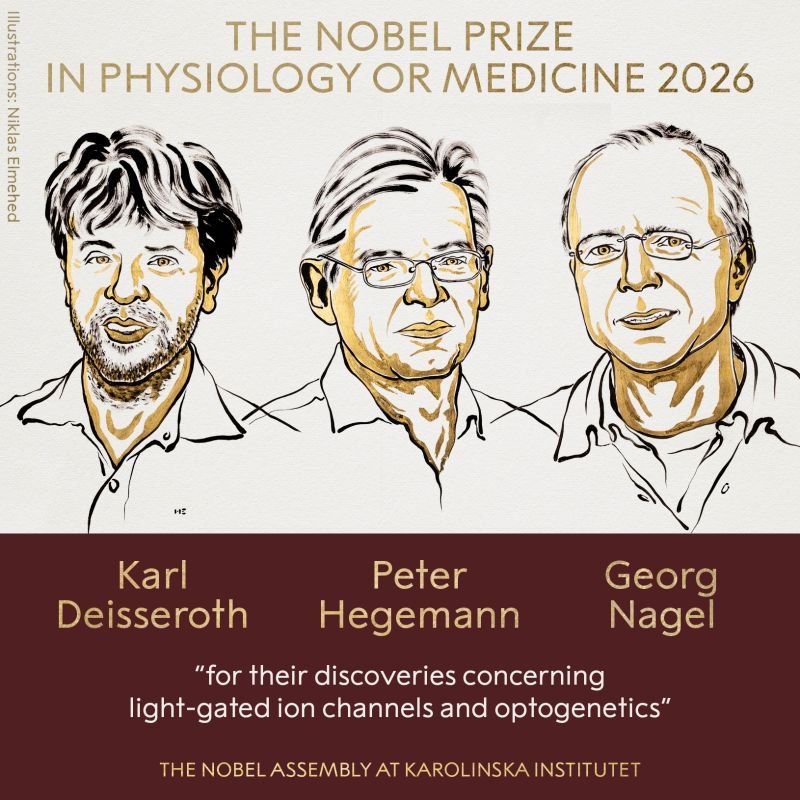
CREDIT: Nobel Prize Outreach