
Researchers have developed hair-thin probes that allow scientists to record the electrical activity of hundreds of neurones simultaneously, a technology that transformed neuroscience research in animals and is now being tested in people.
Understanding how brain cells work together requires recording their activity at the same time. Earlier probes could capture signals from only a few dozen neurones, while techniques such as calcium imaging can be too slow to capture rapid electrical signals and may require genetic modification, limiting their use in people.
Neuropixels probes, developed in 2017 through a collaboration between the Howard Hughes Medical Institute (HHMI), US, and Imec, Belgium, contain hundreds of recording sites, allowing researchers to monitor individual neurones across multiple brain regions. The hair-thin silicon devices are inserted directly into brain tissue and have since been used in thousands of laboratories and adapted for more than two dozen species.
In one collaborative study, the International Brain Laboratory combined recordings from more than 620,000 neurones in 139 mice to map brain activity associated with vision, movement and decision-making. Longer probes were developed to enable recordings from deeper regions of the brain in monkeys. Researchers from HHMI and Imec are further developing the technology to record tens of thousands of neurones in rodents and non-human primates.
In anaesthetised and awake patients during brain surgery, teams at Massachusetts General Hospital and the University of California San Francisco, both US, have inserted modified Neuropixels probes into tissue due to be removed or affected by surgery, successfully recording the neuronal activity of single human cells. A UK team also plans to begin recordings during surgeries that require patients to be awake, which could help reveal how human brain activity supports perception, movement and cognition.
“It’s a dream that we are able to record from large populations of neurones in humans while they are thinking and doing things,” said Mihaly Kollo, researcher at the Francis Crick Institute and Sainsbury Wellcome Centre, UK, for a feature published in Nature.
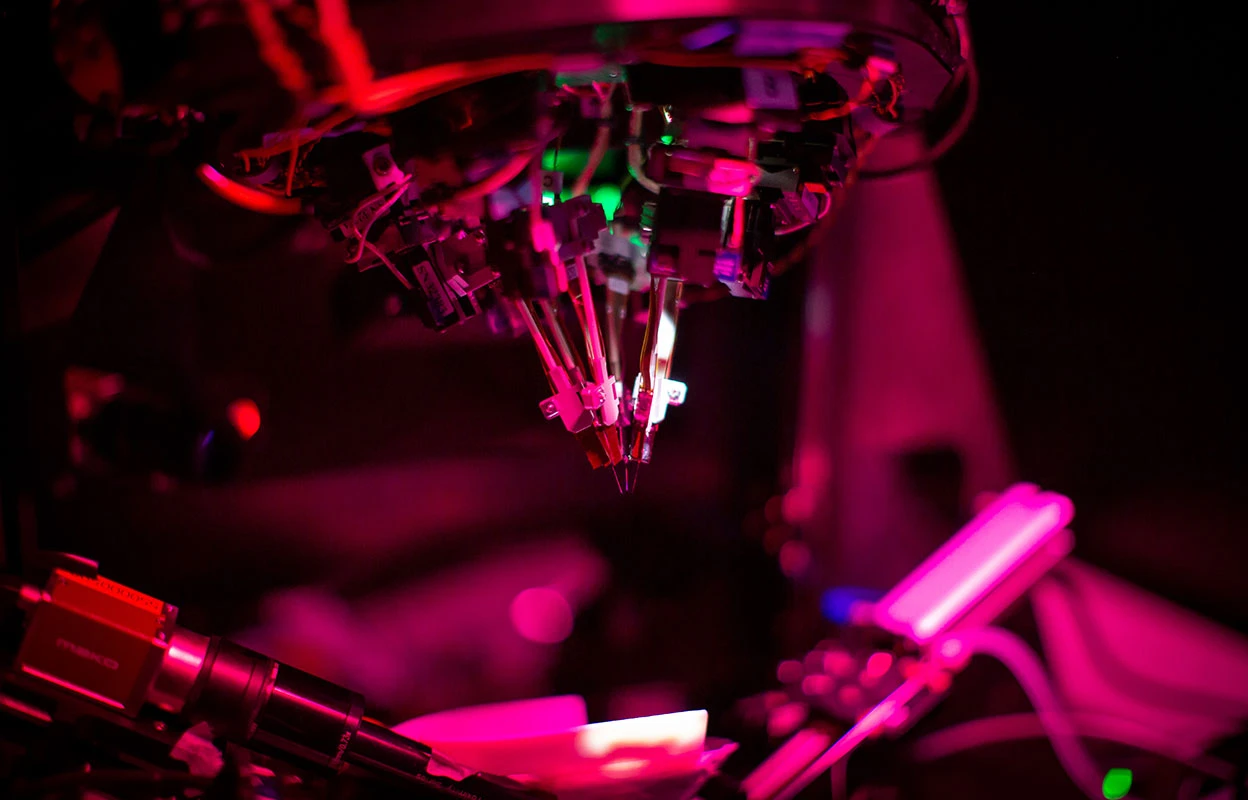
Neuropixels probes are designed to record the electrical activity of hundreds of neurones at once. CREDIT: Allen Institute