
A study from Italy has shown that the pressure generated by the beating heart can limit cancer growth in mice, helping explain why tumours in this organ are so rare.
Although most organs can develop cancer, tumours affecting the heart are rare, suggesting that specific features of the heart may inhibit tumour growth. One distinctive characteristic of the heart muscle is its continuous contraction and relaxation—heartbeat—which generates mechanical pressure as it pumps blood throughout the body.
To investigate this, researchers at the University of Trieste transplanted hearts into the necks of genetically modified mice, creating non-beating hearts. The team then injected cancer cells directly into both the non-beating transplanted hearts and the animals’ normal hearts. After two weeks, cancer cells multiplied and replaced the healthy cells in the non-beating hearts, whereas growth was much more limited in beating hearts—only 20% of the totality of regular heart cells turned into cancer cells.
To complement these experiments, the researchers analysed the cells in isolation in plates and found that cancer cells grew more in non-beating tissue, while growth was reduced in tissue that was made to contract.
“One of the most interesting aspects of this work is that it highlights a dual role for mechanical forces in the heart. They are known to limit regenerative capacity, yet here they appear to exert a protective effect against tumour growth,” said Giulio Pompillio, from the Centro Cardiologico Monzino IRCCS and a collaborator in the study published in Science.
The team is now exploring whether similar forces could be applied to other tissues, such as skin and breast, to limit cancer growth, and whether conditions that burden the heart, like high blood pressure, might have a protective effect against cancer growth.
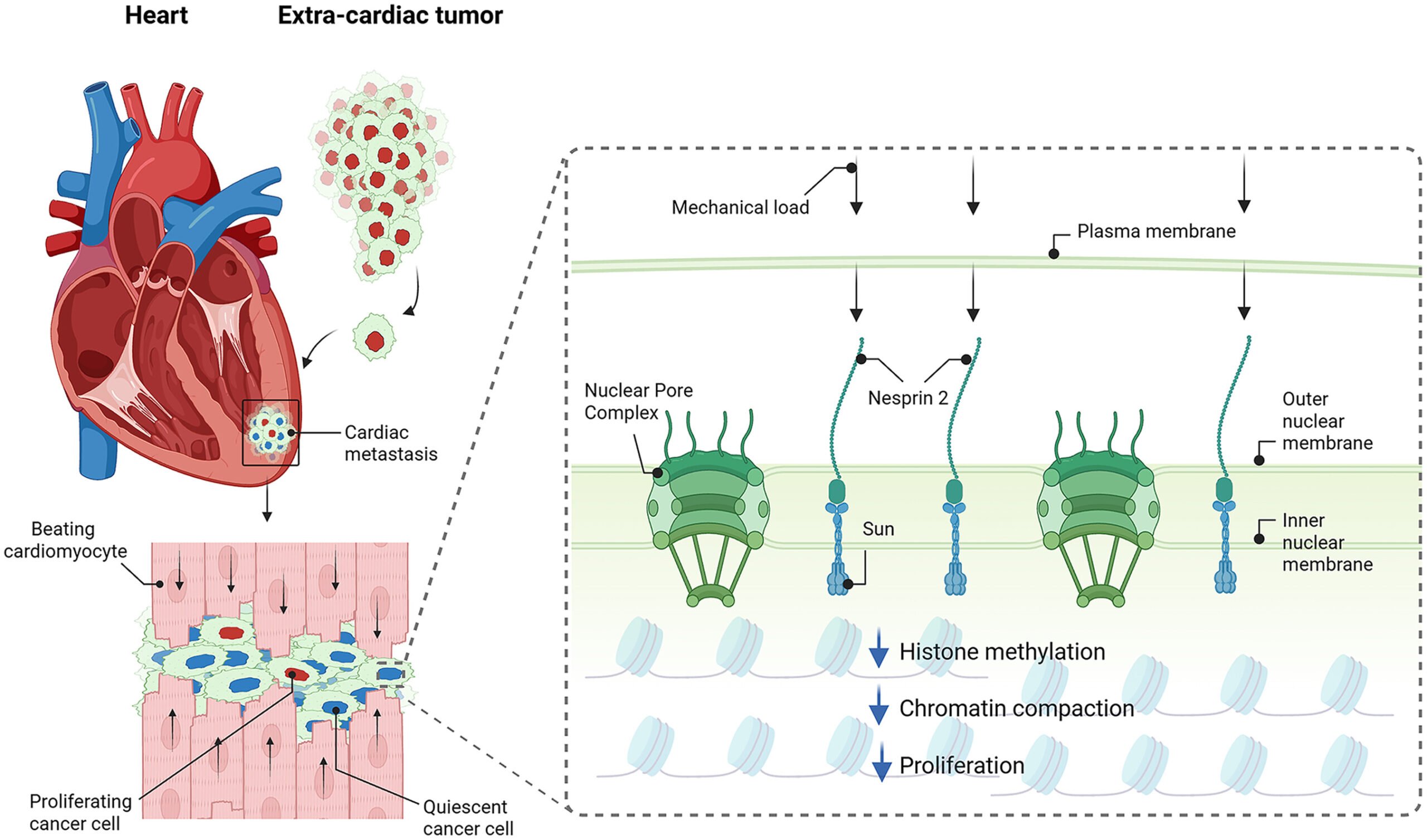
Graphical abstract from article published in Science.Â