
A study in Germany has found that liver cells that accumulate iron help homing pigeons navigate cloudy skies, a finding that may also apply to other animals thatsense the Earth’s magnetic field.
Homing pigeons fly hundreds of kilometres and still return home, but how they can ‘see’ magnetic fields remains a fundamental question of animal behaviour.
Researchers from the Max Planck Institute of Animal Behavior, an EARA Member, and the University of Bonn analysed the magnetic properties of several organs in pigeons, including the eyes, beak, brain, spleen and liver, and found that the liver had the strongest magnetic response.
Analysis of the active genes of the liver cells with magnetic properties, and their location and morphology, led the team to identify them as macrophages, immune cells involved in the destruction of red blood cells that require iron to store oxygen.
By injecting a drug that selectively depletes macrophages in pigeons that had been trained to return to Max Planck’s aviary from nineteen kilometres, the team confirmed that pigeons lacking these macrophages lost their sense of direction on overcast days. Yet, if the sun was visible, pigeons lacking the macrophages could still navigate home, likely using solar cues.
Using electron microscopy, a technique to obtain high-resolution images, the researchers found that iron-rich macrophages were close to nerve fibres. “These findings provide the first concrete evidence of how the Earth’s magnetic field can be perceived within the body and passed on to the brain to guide movement,” said Clivia Lisowski, from the University of Bonn and first author of the study published in Science.
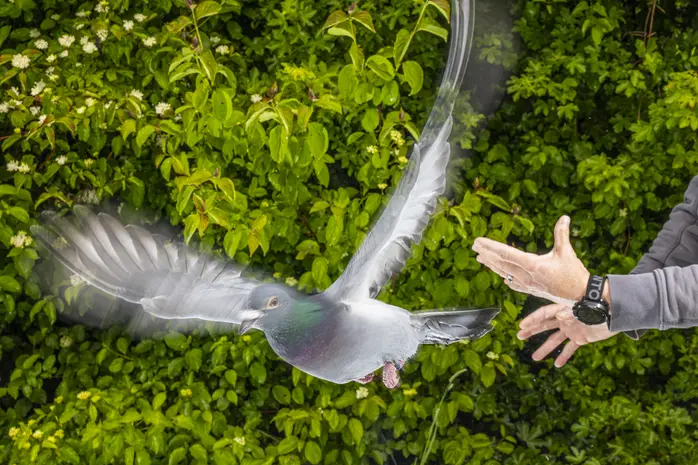
A homing pigeon being released by a scientist at the Max Planck Institute of Animal Behavior.CREDIT: Christian Ziegler / Max Planck Institute of Animal Behavior