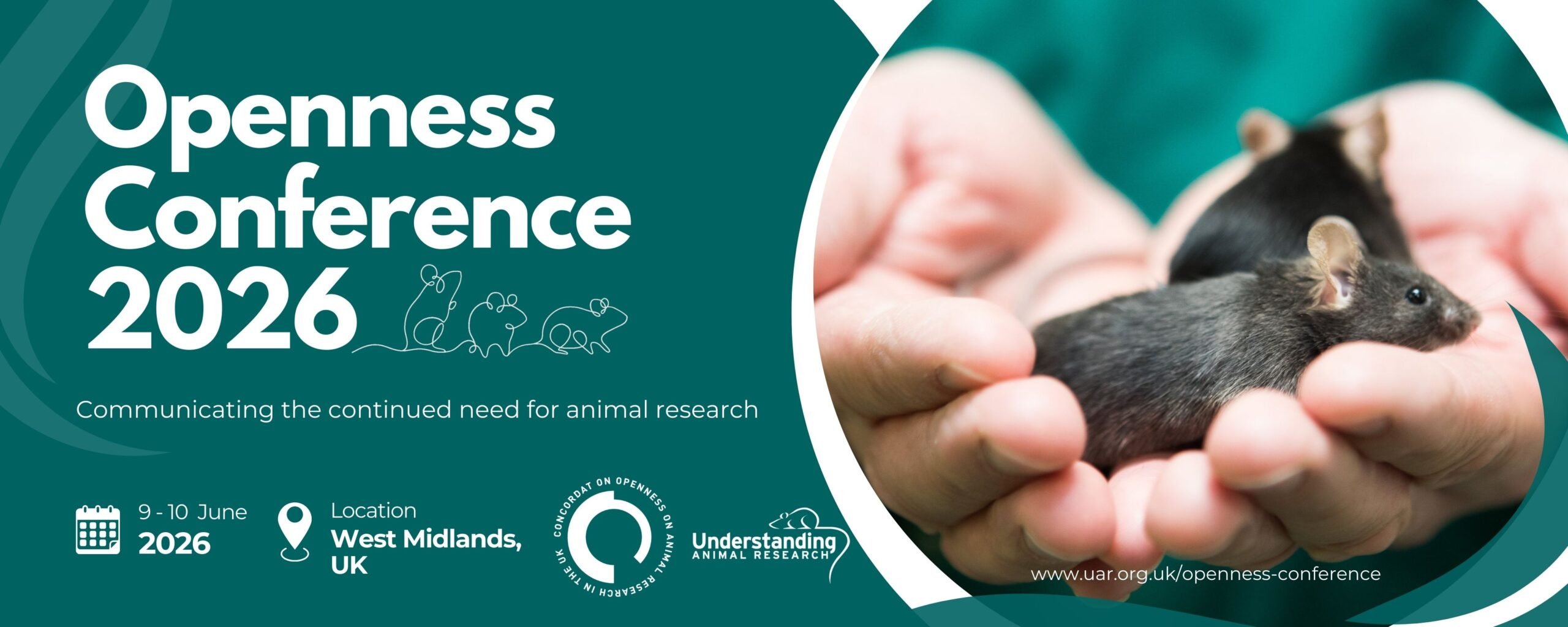
EARA participated in the second Understanding Animal Research (UAR) Openness Conference, which brought together organisations from across the UK, Europe and beyond, contributing to several sessions and discussions concerning transparency, public engagement and communication around animal research.
Ana Isabel Santos, from EARA member NOVA Medical School, in Portugal, and Chair of EARA Members’ Delegates shared how Portugal’s Transparency Agreement is supporting greater openness around animal research, highlighting coordinated commitments by research institutions that are promoting cultural change and public engagement in the country.
Nuno Gonçalves, EARA Deputy Director, led an advanced media training workshop built around case studies provided by participants, which focused on empowering the biomedical community to promote dialogue about animal research. Inês Serrenho, EARA Patient Engagement Officer, presented EARA’s Patient Discovery Project, an initiative that strengthens dialogue between patients and researchers by inviting patients and their families into research environments.
Monique Sundin, EARA Policy Officer, discussed the Open Forum on Animal Research, a Dutch initiative aiming at reducing polarisation by encouraging constructive discussions between researchers working with animals and other models, policymakers, ethicists, research funders and other stakeholders.
Together, Inês and Monique presented the concept of an “Animal Research Open Week”, showcasing examples in Portugal and the Netherlands.
Lord Vallance, the UK Minister for Science, Innovation, Research and Nuclear, in a keynote session, outlined the UK’s strategy for supporting both animal research and the development of approaches that can reduce animal use. He emphasised that any transition must be validated and guided by scientific evidence, announcing plans for a UK centre backed by £30 million in funding dedicated to the validation of methods that can replace and reduce the use of animals.
The conference highlighted how openness around animal research has evolved over the past two decades, with transparency and public engagement now widely embedded across the sector.