
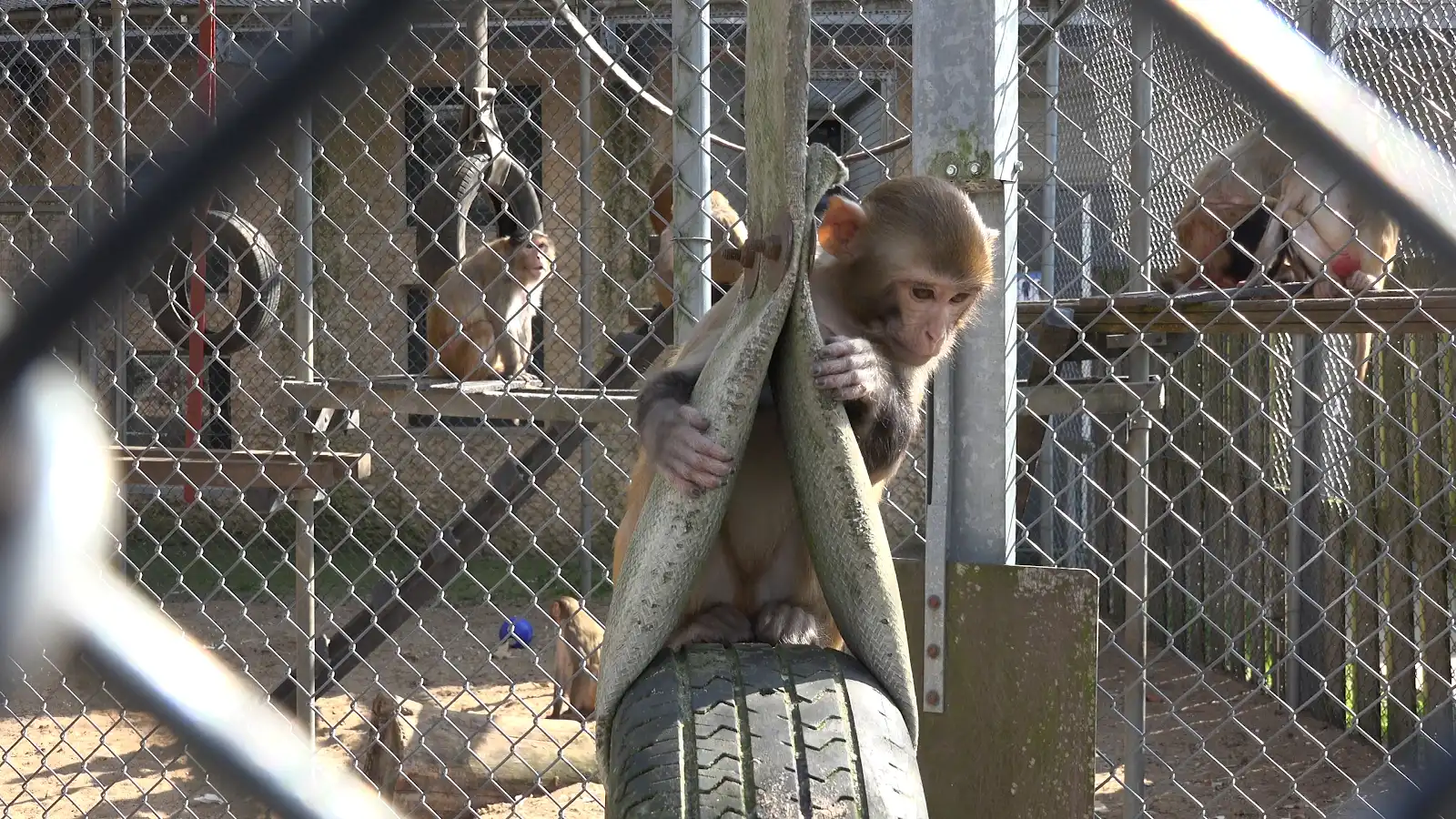
On 27 July the board of directors of Oregon Health & Science University (OHSU) unanimously approved a resolution to direct its president to develop a plan that would substantially reduce the number of monkeys at the Oregon National Primate Research Centre (ONPRC), shift the centre’s focus toward new approach methodologies (NAMs), and end its role as a supplier of research monkeys to laboratories across the United States. This resolution also states the board’s support for renaming the centre and potentially relinquishing its designation as one of the US’s seven National Primate Research Centres. The 64-year-old federally funded facility near Portland houses an estimated 5,000 monkeys.
Background
The vote follows six months of negotiations with the National Institutes of Health (NIH) converting the facility into a sanctuary and ending research there entirely. Those talks ended when it became clear that sustained federal funding to wind the centre down and operate a sanctuary was not going to be available. OHSU President Shereef Elnahal was explicit about the calculation at a staff meeting the week before the vote: if the board approved the new plan, “a bill to close us would not be in play,” citing private conversations with legislators.
This is the outcome of a sustained campaign against the centre. PETA has run a named campaign to shut ONPRC down, describing the facility as "violation-plagued" and maintaining a rolling page of campaign updates alongside a dedicated page targeting the centre. The Physicians Committee for Responsible Medicine (PCRM) backed the sanctuary proposal. PETA itself attributes the momentum to pressure from its own campaign, PCRM, Oregon legislators, Governor Tina Kotek and "hundreds of thousands of Oregonians."
That pressure has also taken a legislative form. OHSU was required to respond to a state legislative budget note on the centre's future, and in January 2026 the OHSU board publicly contemplated closure while the centre's scientists pleaded for support. Separately, Initiative Petition 28 — the so-called PEACE Act — would have extended cruelty protections to animals in laboratories, in effect criminalising animal research in the state. It failed to qualify for the November ballot in July 2026, with roughly 104,000 of some 142,000 submitted signatures validated.
What the resolution does and does not say
The plan directs ONPRC to substantially reduce the colony size, sending many animals to existing sanctuaries; cease breeding, dropping the maintenance of genetic diversity in the colony as an institutional priority; end the sale of monkeys to outside investigators: continue only those primate studies OHSU determines are unique to the centre and become a “national leader in research on the development of NAMs”. That caveat cuts directly against the narrative pushed by PETA and PCRM, which has presented the resolution as a signal of the eventual end of primate research at the centre.
However, there is no timeline, no target colony size, and no identified funding source for the proposed NAM 'pivot'. The NIH has also not said whether it would support the changes. The NIH had been prepared to help fund the sanctuary version of this plan; it has offered nothing for the NAM-pivot resolution that replaced it once the sanctuary talks collapsed. Elnahal told staff that "not much is going to change in the next couple of years, most likely," and declined to give reporters a ballpark figure for what "substantially" means. He expects a comprehensive plan by early next year, as part of a wider OHSU strategic plan.
What the Scientists told the Board of Directors
ONPRC Director Skip Bohm welcomed new institutional investment in NAMs, while noting the centre has spent more than two decades developing such methods and that “new methodologies still require validation in animal models”, because current technology often cannot replicate the necessary complexity. OHSU neurologist Dr Joseph Quinn pointed to the role of primate research in developing deep brain stimulation for Parkinson’s disease: “I’m not aware of any new approach methodology that can replace primates in this work.” Elnahal himself argued the bottleneck for emerging models is validation — determining whether they accurately predict outcomes — and that OHSU is one of few institutions able to do that rigorously.
Two researchers raised implementation concerns. Christopher Kroenke, professor of neuroscience at ONPRC, questioned how “unique” research would be identified at all: most work at the centre is funded by competitive NIH grants, and “you don’t get in the top 10 percent by proposing something that somebody else can do.” Rachael Wolters, research assistant, professor of pathobiology and immunology, noted that another facility being technically capable of similar work does not mean it has the capacity to absorb it, and raised questions about academic freedom. Both said they were speaking personally.
Beyond the two researchers who spoke individually, there was a wider organised response. Rachael Wolters — the same pathobiology professor who raised academic-freedom concerns above — is also involved with Oregon Voices for Biomedical Research, a coalition of ONPRC veterinarians, scientists, healthcare professionals and patients formed once talk of closing the centre began. Funded through a GoFundMe page, the group ran a billboard, bus and social media campaign across Oregon directing the public to research projects — on endometriosis, foetal brain development, paediatric anaesthesia and inherited blindness — that it says would be lost if the centre closed. "Normally, a junior faculty would just need to focus on writing grants and publishing papers, and instead, I'm fighting for the right to still be a scientist," Wolters told The Transmitter. That a bottom-up coalition of working scientists organised its own public campaign is worth noting on its own terms.
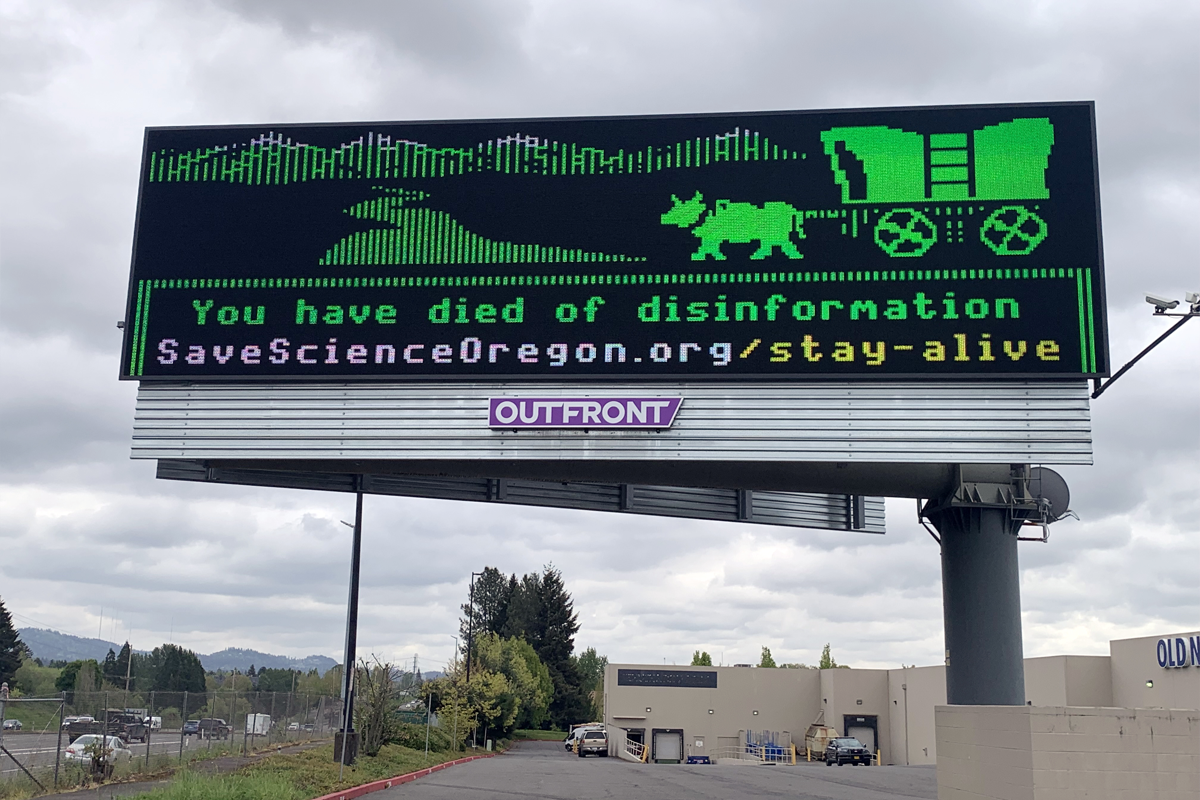
Oregon Voices for Biomedical Research billboard forwarding to a website where users can learn more about primate research. CREDITS: Oregon Voices for Biomedical Research
Beyond Oregon
ONPRC sold 120 monkeys to outside research institutions during the 2024–25 fiscal year, according to an OHSU report to the state legislature. The United States has a shortage of non-human primates that was exacerbated by the COVID-19 pandemic and yet to recover. A 2023 report by the National Academies of Sciences, Engineering, and Medicine concluded that reliance on imported non-human primates “undermines the security of the U.S. biomedical research enterprise,” and recommended that NIH invest in and expand domestic capacity. Peter Strick, professor and chair of neurobiology at the University of Pittsburgh and a member of that committee, said the 268-page report “has been ignored entirely by the people in Oregon”. Ricardo Carrion Jr., director of the Wisconsin National Primate Research Center, said taking a centre offline would affect training opportunities for veterinarians and scientists as well as the pool of available animals.
“Rebranding”
The resolution’s support for a rebrand is not incidental. Four of the seven US national primate centres have already replaced “primate” with “biomedical” in their names. Elnahal framed the change as reflecting a strategic refocus toward the 3Rs.
This matters more at ONPRC than it might elsewhere, because the centre has not been a closed institution. It runs in-person tours for school and public groups of up to 50, taking visitors to the rhesus and Japanese macaque breeding colonies, and publishes a virtual tour for those who cannot attend. Its outreach programme sends scientists into classrooms, runs a speakers bureau, and hosts high school apprenticeships, undergraduate fellowships and veterinary and vet-tech externships. It publishes public pages on how the animals are cared for and on oversight. When PCRM ran an advertising campaign against it, OHSU responded publicly and addressed the claims point by point rather than declining to comment. Oregon also has a 2023 transparency law requiring OHSU to report publicly on the centre’s primate population and welfare incidents.
That is what openness looks like in practice, and the centre deserves enormous credit for it. Precisely because of that the naming question is worth separating from everything else. Institutions that quietly remove the word do not necessarily become more open. They become harder to hold to account, and they concede the argument before it has been made. Public confidence in biomedical research rests on institutions explaining what they do and why — not on making the information harder to find. This accusation cannot be levied at the centre.
The European parallel
None of this is unfamiliar on this side of the Atlantic. In the Netherlands, lawmakers have repeatedly moved to curtail primate research, and in 2025 both houses of parliament backed a plan to end public funding for the Biomedical Primate Research Centre (BPRC)by 2030, a measure that the Dutch government has thankfully opposed and now reversed. In Germany, when campaigners petitioned the Bundestag (the German Parliament) on an EU-wide end to primate studies, the national research funder, the research ministry and the main parties defended the research, warning a ban would drive research abroad before replacements exist.
Oregon had no equivalent when its moment arrived, and that gap in preparedness and influence, more than anything in the science, is the real story of how this decision got made. That coordination is newer on this side of the Atlantic than it might appear, too: Europe's primate centres signed their first ever joint declaration on collaboration only in May 2026, at the inaugural PrimeMeet Europe congress in Haarlem. EU- Simia, an organisation coordinated by the European Animal Research Association (EARA) and Inserm, the French National Institute of Health and Medical Research, which is seeking to connect all NHP researchers in Europe through one organisation, is only three years old. Organised coordination on this issue is in its infancy not an established norm, on either side of the Atlantic.
What is to be Done
The equally uncomfortable issue is how this was all decided. For eighteen months, despite valiant attempts by the ONPRC, essentially only one side of this argument was in the newspapers, on billboards, in the legislature and in front of the governor. There was no comparable presence on the other side — not for want of willingness at the centre itself, but because no sustained, sector-wide effort existed to put one there.
That is the lesson for every research institution watching this, and it is not a criticism of Oregon at all. Quite the opposite. ONPRC opened its doors further than most, and it still ended up here — because openness practised by one institution cannot offset the reluctance of an entire sector shift from being reactive to being proactive.
Efforts to build that shared approach already exist. The U.S. Animal Research Openness (USARO) agreement, launched at the 2025 National AALAS meeting, has brought ten research institutions — including Charles River, Labcorp, AstraZeneca and Emory's National Primate Research Center — to sign a public openness agreement, with organisations such as Americans for Medical Progress and the American Association for Laboratory Animal Science (AALAS) supporting it as allies.
That is real progress, and it deserves credit rather than any implication that nobody tried. The issue is one of scale, not effort: a voluntary agreement among a dozen or so organisations cannot yet stand in for participation across the many thousands of US institutions that conduct animal research, and it is that gap, not an absence of willingness, that a sustained campaign will keep finding and exploiting. Nor is the problem confined to primates — the same coordination gap runs through work with mice, rats and every other species used in research. USARO is a pioneering effort, and one we hope grows well beyond its founding signatories. Transparency introduced only once a campaign is under way is already too late. By then the public has been given an account of what happens inside research institutions, nothing has been set against it, and no particular reason to doubt it has been offered.
The response to this cannot be more firefighting. Firefighting is a losing position by definition: it concedes the framing, it is defensive, and it reaches only the people already following the story. What the sector needs to do together is the opposite posture — sustained openness campaigns, run even when pressure seems slight, putting the case for this research in front of the public long before anyone is asked to vote on it. The audience for that work is not the committed opponent, who will not be moved, and it is not the research community, which is already convinced. It is the large percentage standing in the middle ground: people with no settled position, uneasy about animal research in the abstract, who have never set foot in a facility and have never been given a reason to think about it. They are reachable. Activists have understood for years that this is where legislatures and ballots are won and have acted accordingly.
And in that conversation the most credible voice is not groups such as EARA or even just the scientists. It is the patient: the person waiting on a Parkinson's therapy, the family living with a rare disease, the millions for whom HIV is now a manageable condition rather than a death sentence. They have a moral standing in this debate that neither side currently claims and they are almost never asked. That is precisely why EARA runs its Patient Discovery Project. The case for this research is not, in the end, a case about laboratories. It is a case about medicine and discovery, and it belongs to the people who depend on it. ONPRC did more than most and still ended up here. That is not evidence that openness fails. It is evidence that it cannot be left to one institution at a time and cannot begin on the day the activists announce their latest target.
Kirk Leech
EARA Executive Director