
Researchers in Switzerland have developed lab-grown organoids that can cyclically simulate the tissue renewal that occurs after menstruation, which can potentially offer new insights into the understanding of uterine diseases.
Researchers at the Friedrich Miescher Institute for Biomedical Research (FMI) obtained human uterine cells from biopsies and separated the cells on the surface of the uterus, epithelial cells, from the rest.
Then, the team allowed them to grow into miniature, organised spheres, called organoids. By reproducing the natural cycles of hormones, oestrogen and progesterone, the organoids mimicked the cellular processes of menstruation. Since they lacked the cells responsible for shedding of the tissue, the researchers mechanically destroyed the tissue to replicate the physical aspects of menstruation. The organoids then regrew, allowing the study of subsequent tissue regeneration.
“Despite affecting hundreds of millions of women every day, menstruation has historically received little scientific attention, and we wanted to create a model that could finally open this ‘black box’,” said Margherita Turco, researcher at FMI and leader of the study in Cell Stem Cell.
By analysing the genes that are active in the organoids during this process, the team found a gene called WNT7A, which was already known to be important for tissue regeneration in primates - a likely driver of regeneration in humans too. By using gene-editing to delete it from the organoids, they found that they could not survive long-term, suggesting that the regenerative role of WNT7A is conserved in humans.
Future research will aim at increasing the complexity of the model by introducing other cell types that are also present in the uterus, to study more advanced processes such as endometriosis, amongst others.
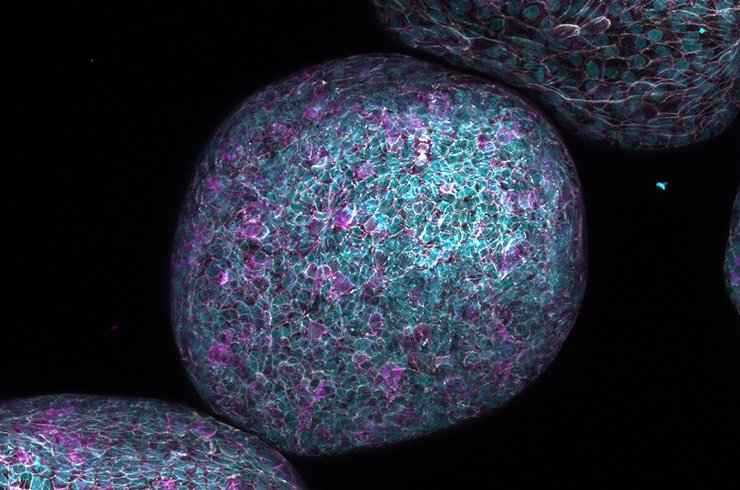
Organoids. CREDITS: FMI