
A study from Canada and the US has found that some repetitive behaviours in monkeys are not just a response to recent stress, but can be linked to an animal’s life experiences.
It is not uncommon for monkeys in research facilities to display abnormal repetitive behaviours (ARBs) such as pacing, rocking or pulling out their own hair. These have generally been attributed to specific recent stressful situations (stressors), such as being moved, housed alone or undergoing a procedure.
Researchers at the University of Guelph and two US National Primate Research Centers, in California and Oregon, conducted a study involving 240 rhesus macaques. They started with remote cameras to monitor animal behaviour while in cages and found nearly 60% of the macaques displayed ARBs.
After analysing detailed lifetime records from each facility, the team identified 12 stressor types, including recent situations like being caged in noisy areas or isolated, as well as past events like the loss of their mother in infancy. Animals exposed to more stressors were more likely to exhibit more ARBs, around 50% with each cumulative stressor.
Although the results varied and the cause-and-effect relationship could not be determined, trends suggested that different experiences were associated with different ARBs: for instance, hair-pulling was linked to current stressors, while pacing and rocking were linked to past events.
The California NPRC stated these findings, published in Biology Letters, highlight the institution’s “commitment to continuously improving animal care. Linking lifetime experiences to behaviour provides actionable insight that directly informs refinements in housing, socialisation, and behavioural management to better support welfare.”
Quotes from experts (not involved in the study):
Jean Laurens, Ernst Strüngmann Institute (Germany):
This study was conducted on monkeys housed in cages consistent with common U.S. standards, i.e. approximately 1 m³ or less. By contrast, the EU minimum legal requirements for macaques and vervets specify enclosures of at least 2.0 m² floor area, 1.8 m height, and 3.6 m³ volume, with many institutions providing much larger enclosures. Such increased space fundamentally transforms enrichment and physical activity opportunities, allowing animals to climb, explore, and move in three dimensions using branches, ropes, and elevated platforms, conditions that are simply not possible in small cages.
This distinction is highly relevant, as the housing conditions in this study are themselves likely to constitute a significant stressor and contributing factor. This context likely contributes to the high proportion (~60%) of macaques exhibiting abnormal repetitive behaviours. It also highlights two important limitations of the study: first, it could not meaningfully assess how enrichment might mitigate negative experiences under more natural housing conditions; and second, the findings are not necessarily representative of standard practices in the EU, or of the typical quality of life of primates housed in EU laboratories.
Overall, this study highlights the importance of supporting NHP research within European frameworks, where conditions are in place to meet higher animal welfare standards. It also reinforces, based on my experience in NHP neuroscience, that housing and husbandry practices are among the primary determinants of animal welfare; often more so than the scientific procedures themselves.
Kristine Krug, Professor and Principal Investigator at Otto-von-Guericke University Magdeburg (Germany) and Visiting Professor at the University of Oxford (UK):
“This study adds to the growing body of research showing that a wide range of life experiences, especially early ones, correlate with well-being. A critical next step is to understand better the causal effect of specific life events, including animal experimentation and also in connections with genetic predisposition, on welfare. This research should contribute to improve animal welfare in a wide range of settings and to our understanding of abnormal repetitive behaviours across species including humans.”
Emmanuel Procyk, Chair of EU-Simia, the European network for primate research, and Principal Investigator at Stem cell and Brain Research Institute (SBRI) – INSERM (France):
“This article in Science news refers to a paper published in Biology Letters that reports an analysis of abnormal behaviors in captive monkeys across two American primate centers. The study examines the relationship between these behaviors and the animals’ current or past experiences. Such research is crucial because it contributes to the challenging task of quantitatively and scientifically assessing the well-being of animals and how their life experiences impact their physical and mental health.
Even if, as the authors acknowledge, this particular study has limitations and requires further investigation to explain discrepancies between centers and measurement methods, we need more of this kind of research. The findings suggest that life experience significantly affects negatively some animals and reveal resilience in others—a result that aligns with expectations, given what is already well-documented in humans. There are also compelling studies on how exposure to natural threats or aversive events (such as natural disasters) influences behavior and health in primates.
However, the measures used in this study do not fully account for scientific procedures or their severity. Instead, they primarily focus on negative life experiences, such as social separations, interactions, and housing conditions. The study also reveals that some abnormal behaviors are more strongly influenced by the animals’ current situation than by past experiences. This is particularly important because these conditions can be modified, improved, and tailored to individual needs to mitigate negative consequences.”
Even if, as the authors acknowledge, this particular study has limitations and requires further investigation to explain discrepancies between centers and measurement methods, we need more of this kind of research. The findings suggest that life experience significantly affects negatively some animals and reveal resilience in others—a result that aligns with expectations, given what is already well-documented in humans. There are also compelling studies on how exposure to natural threats or aversive events (such as natural disasters) influences behavior and health in primates.
However, the measures used in this study do not fully account for scientific procedures or their severity. Instead, they primarily focus on negative life experiences, such as social separations, interactions, and housing conditions. The study also reveals that some abnormal behaviors are more strongly influenced by the animals’ current situation than by past experiences. This is particularly important because these conditions can be modified, improved, and tailored to individual needs to mitigate negative consequences.”
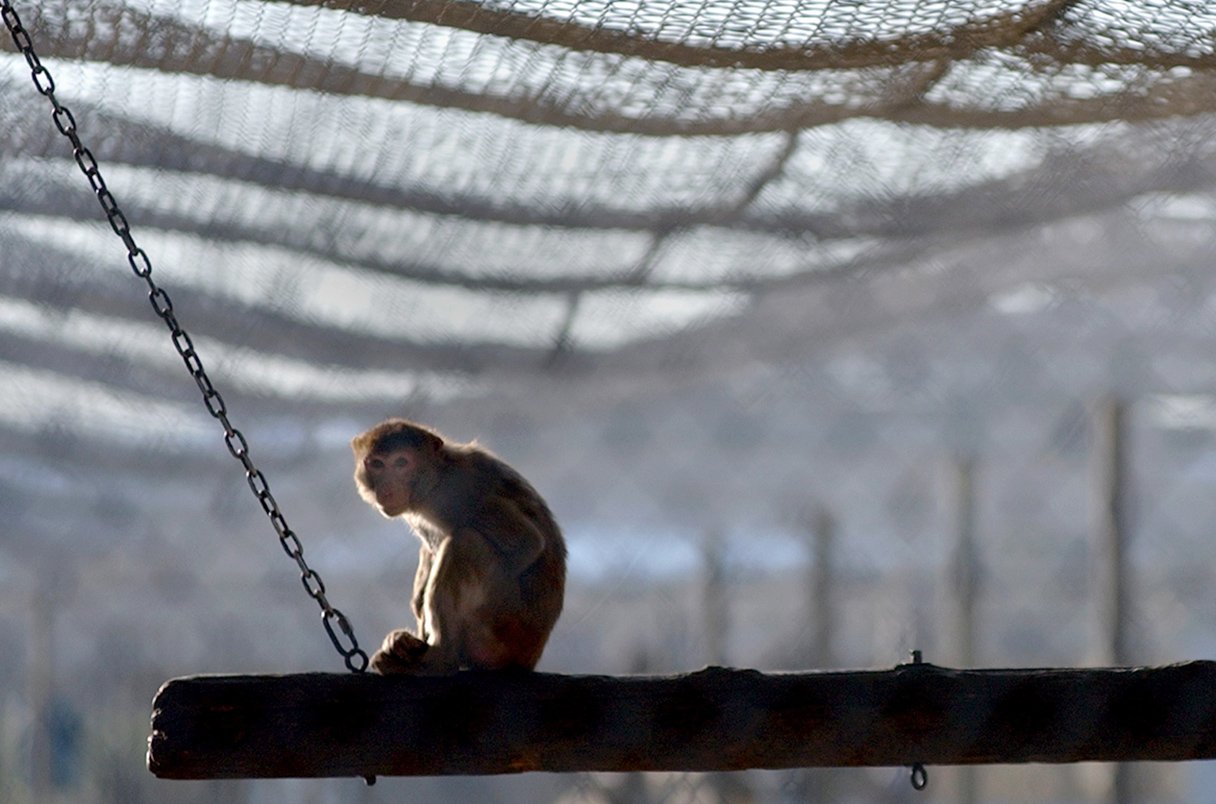
A rhesus macaque at the California National Primate Research Center, one of two facilities that took part in a new study. CREDITS: JAY MATHER/ZUMA