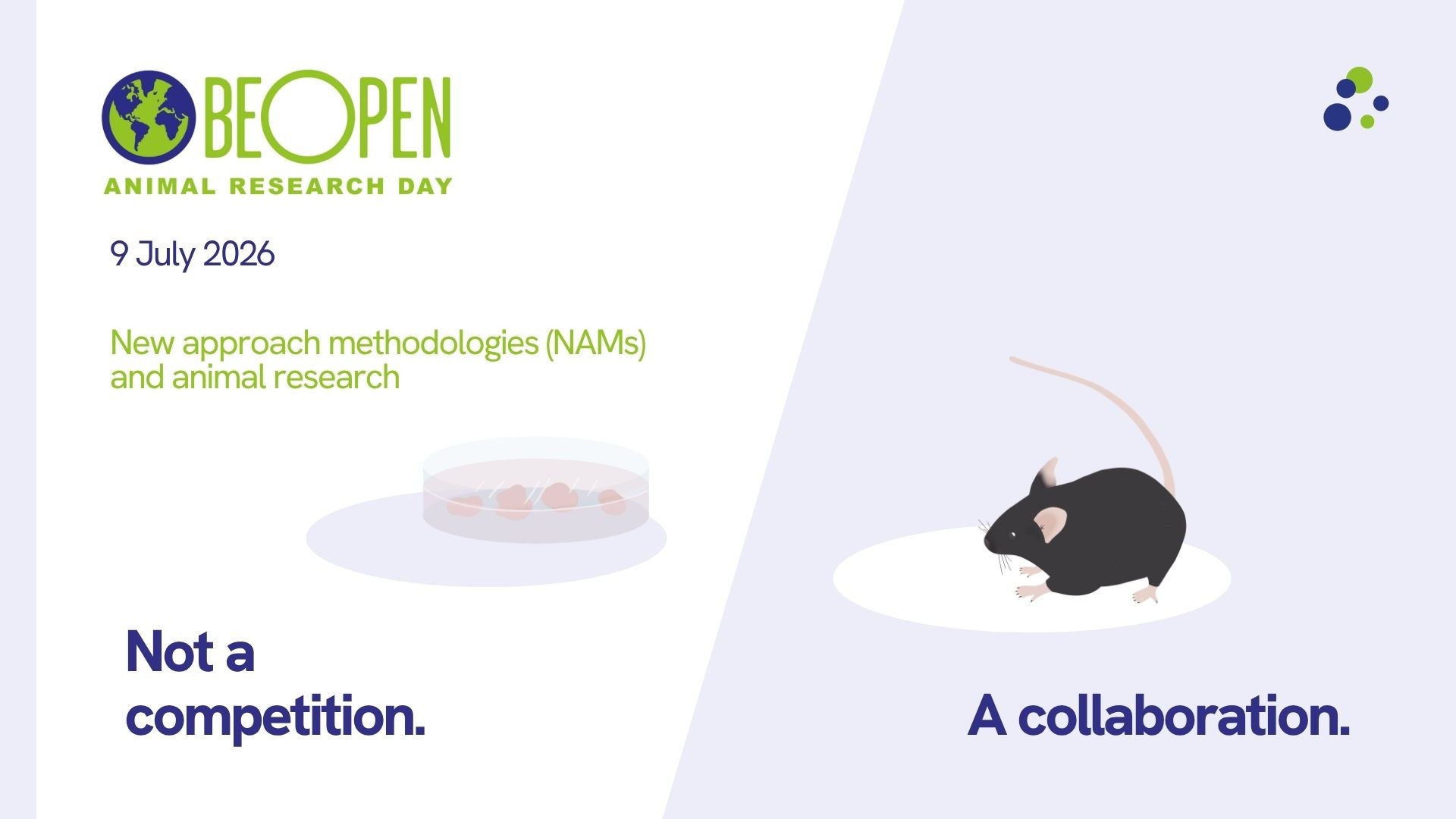
The biomedical community around the world shared a unified message during EARA’s Be Open About Animal Research Day (#BOARD26) campaign: animal studies and other approaches are complementary.
#BOARD26, EARA’s global social media campaign, took place on 9 July 2026 with unprecedented participation addressing the complementarity between animal research and new approach methodologies (NAMs) such as organoids, computational models and organs-on-chips.
More than 300 contributions, from 37 countries, put forward a central idea: animal models remain essential for studying complex processes in living organisms, while NAMs provide crucial mechanistic insights. Most research already involves both approaches — each model is used according to the scientific question, and animals are not used when alternatives exist. By sharing video and written statements, interviews, podcast episodes, case studies and infographics, which can be accessed on EARA’s website and social media platforms, the biomedical community highlighted how they welcome the advancement and increasing complexity of NAMs and studies with animal models alike, reiterating that, in science, approaches that integrate multiple models are the only way to forward scientific progress.
Researchers in Egypt, Nigeria and Uganda also warned that phasing out animal research could disproportionately affect countries where access to NAMs remains limited. Meanwhile, institutions in Portugal and Germany organised visits to the animal facilities and open days to demonstrate how different research models are used together in biomedical research. At Instituto de Investigação e Inovação em Saúde (i3S), an EARA member in Portugal, the public event was covered by journalists,resulting in a national news piece on the ethical oversight of research using mice.
At a time when NAMs and animal research are often portrayed as competing, a narrative that can negatively impact science by decreasing public trust and by limiting crucial research, participation in this campaign demonstrates that scientists from all fields of research are ready to openly support all science and engage with the public to promote evidence-based information.