
A study in the US has found that a protein involved in communication between cells helps Alzheimer’s disease spread to healthy regions of the brain in mice.
The accumulation of tau protein leads to neurone death and is a hallmark of Alzheimer’s disease.
Researchers at the University of Utah discovered that Arc, a protein that wraps around itself to form round microscopic vesicles that allow for communication between cells by floating from neurone to neurone, is crucial for the toxic protein tau to spread in the brain.
In cultured brain cells from mice and rats, the researchers found that vesicles contain tau protein and that Arc is involved in the release of tau protein from the vesicles. Similarly, in the brain, they found that tau protein accumulates in brain vesicles of mice genetically altered to have Alzheimer’s symptoms due to accumulation of tau in neurones, which coincided with more neurone death. But, in mice that were genetically engineered to lack Arc protein, the amount of tau in vesicles and the spread of tau to other neurones was reduced. In post-mortem brain tissues from Alzheimer’s patients, the team also found that Arc vesicles contain tau, which suggests that a similar mechanism may be involved in tau spread in the brain in humans.
Future research will focus on blocking the vesicles containing tau from reaching healthy cells. “If we could target these particular EVs [vesicles], that would be a really useful therapy strategy. For someone with early-onset Alzheimer’s or dementia, if we could stop the spread, then we could prevent further damage and cognitive decline,” said Jason Shepherd, from the University of Utah and leader of the study published in Cell.
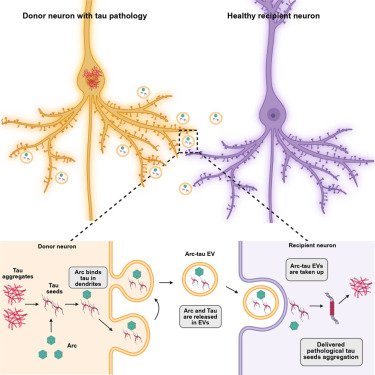
Graphical abstract from Cell.