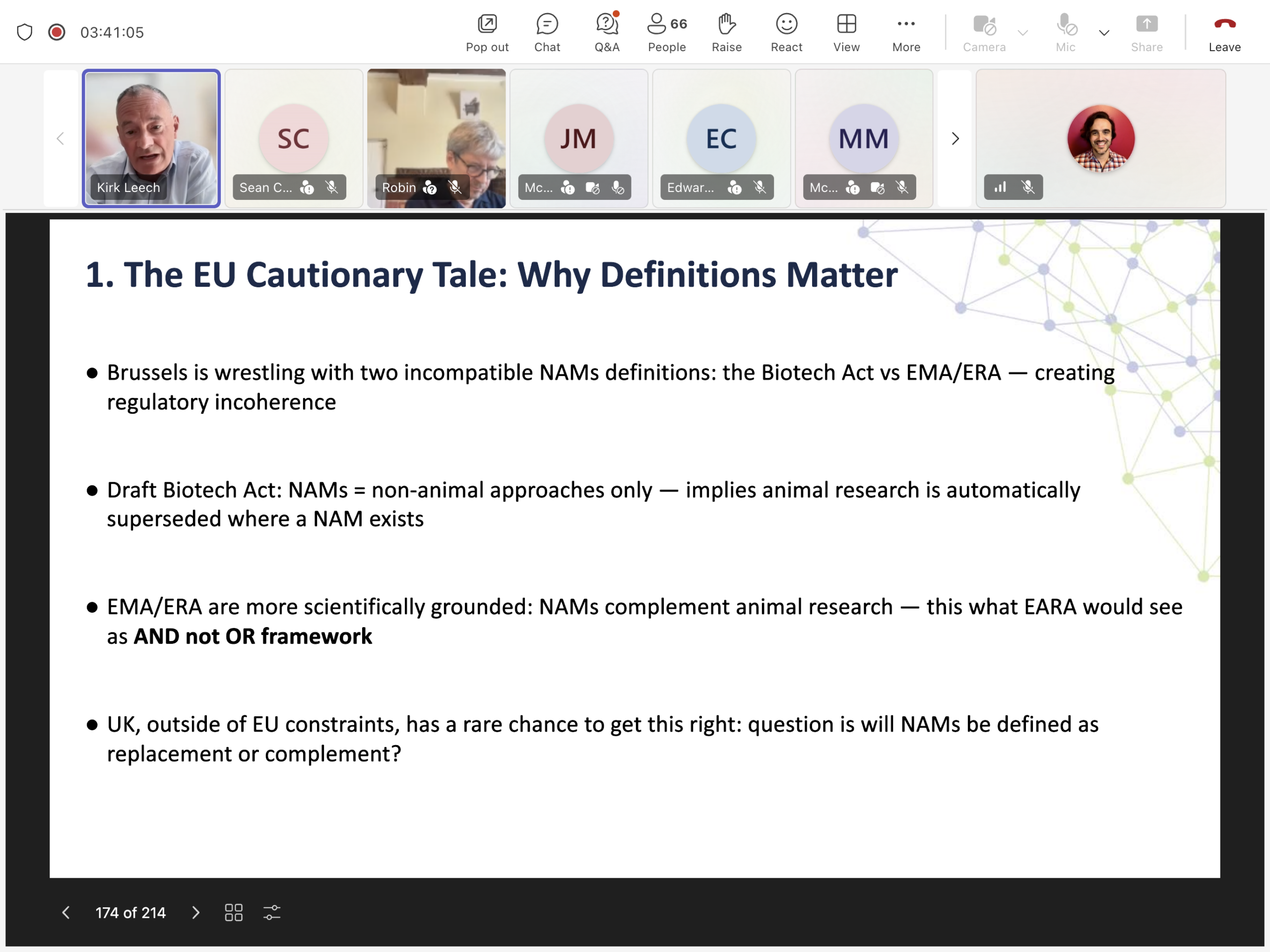
EARA Executive Director Kirk Leech spoke at the Westminster Health Forum conference on transitioning to new approach methodologies (NAMs), held on 29 June, where he drew on international developments and the lessons they hold for the UK.
Kirk pointed to the EU as a cautionary tale on the adoption of NAMs. Brussels is currently wrestling with two incompatible definitions: the proposed Biotech Act defines NAMs as non-animal methods only, risking the implication that animal research is automatically superseded wherever a NAM exists, regardless of whether it has been validated for the endpoint in question. In contrast, the European Medicines Agency (EMA) guidance and the European Research Area action plan treat NAMs as complementary to animal research rather than a replacement for it. Kirk argued that the UK has a rare opportunity to adopt a science-led framework from the outset.
He also highlighted the potential public trust gap, noting that exaggerated claims that NAMs will “end animal testing” create expectations that current science cannot meet. Drawing on the Netherlands, where parliament voted in 2025 to phase out public funding for the Biomedical Primate Research Centre by 2030, Kirk warned that reducing domestic non-human primate (NHP) research capacity risks increasing dependence on research carried out abroad while weakening scientific expertise and pandemic preparedness. He concluded by highlighting the UK Medicines and Healthcare products Regulatory Agency’s (MHRA) March 2026 guidance on NAMs as a model of science-led pragmatism, by recognising that these are not expected to replace animal studies on a one-to-one basis.
The conference brought together regulators, scientists and industry representatives to discuss the transition to NAMs. Speakers included representatives from the NC3Rs, the UK Home Office, the MHRA, the Office for Life Sciences, academia and industry, with discussions covering regulation, funding, research infrastructure, evidence standards and international developments.