
Researchers in Germany have identified a marker of aggressive and treatment-resistant colon cancer and shown that it can be targeted with an already approved drug using patient-derived tumour organoids and mice.
Colon, or colorectal cancer more specifically, is the third most common cancer worldwide and is particularly difficult to treat once it has spread to other organs. One reason treatment becomes less effective is that cancer cells can change their behaviour during therapy, allowing them to survive and resist treatment.
A team led by the German Cancer Research Center (DKFZ) identified that high levels of TROP2, a protein found on the surface of a small population of cancer cells, were linked to a higher risk of relapse and cancer spreading (metastasis) in colorectal cancer. These cells with TROP2 behaved like stem cells, which can divide quickly and self-renew, contributing to tumour regrowth and spread.
The researchers tested already approved drugs that target TROP2 in breast cancer in tumour 3D cultures (organoids) grown from patient samples and in mice implanted with human colorectal cancer cells. In both systems, drugs that target TROP2 reduced tumour growth and the spread of cancer cells. When combined with standard chemotherapy in mice, the TROP2-targeting drugs were more effective than either treatment alone.
“By combining chemotherapy with TROP2 blockade, we can specifically target the cells that are primarily responsible for relapses and metastases. Since the drugs targeting TROP2 are already approved, we were able to translate our laboratory results into clinical trials relatively quickly,” said René Jackstadt, from DKFZ and lead author of the study published in Nature.
The TROP2-targeting drugs are already being tested in patients with advanced colorectal cancer in a phase 2/3 clinical trial.
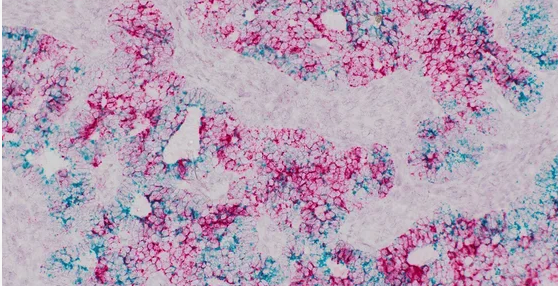
A tissue section of a colorectal cancer. CREDITS: DKFZ