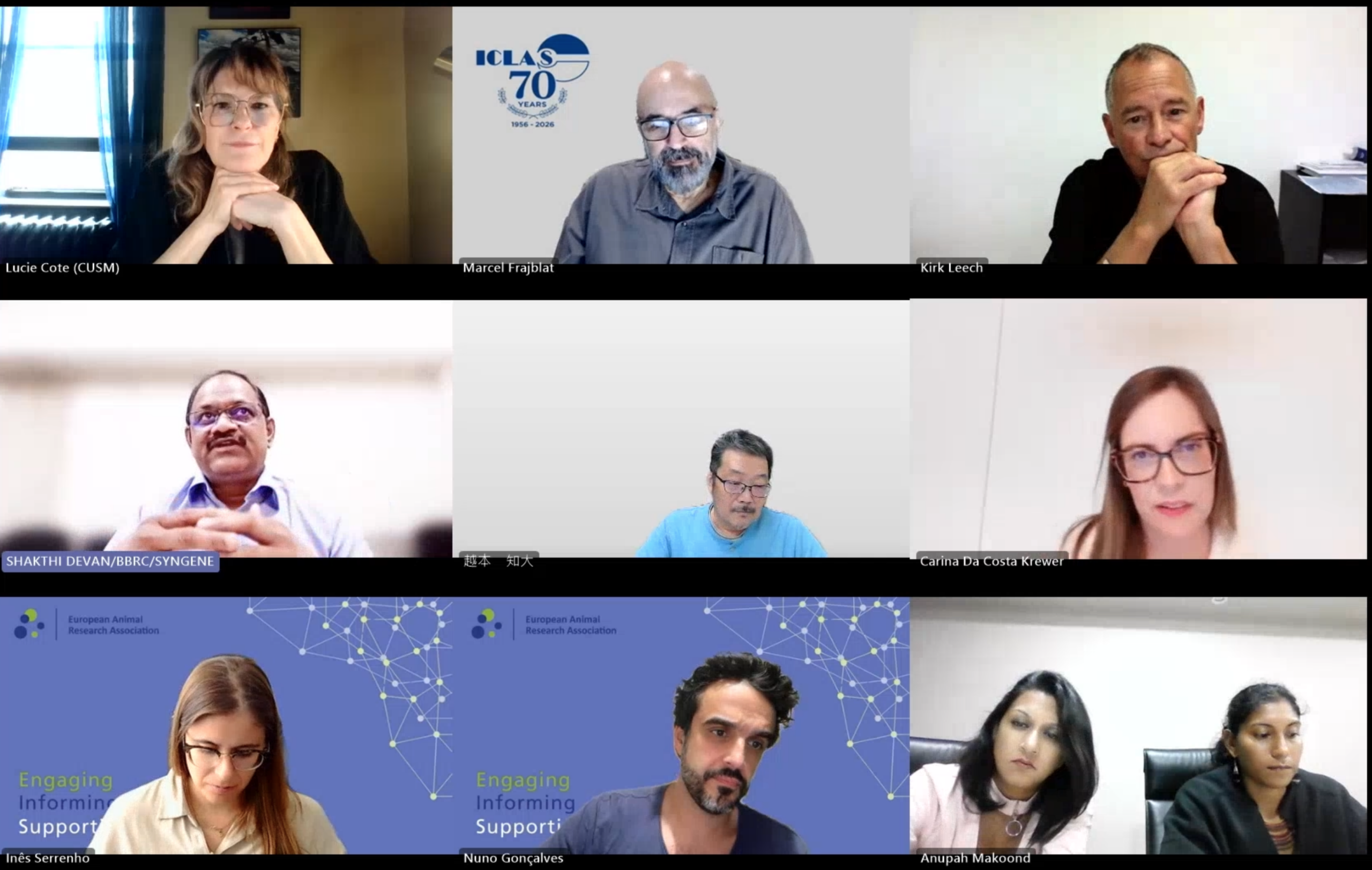
EARA hosted a special webinar with the International Council for Laboratory Animal Science (ICLAS), “Global Dialogues on Laboratory Animal Science”, on 14 July 2026 as part of ICLAS’s 70th anniversary, bringing together speakers from Africa, South America, Asia and North America to explore how transparency in animal research is developing across different regions of the world.
Opening the webinar, Marcel Frajblat, Secretary General of ICLAS, framed transparency as central to the future of laboratory animal science, and Kirk Leech, Executive Director of EARA, underlined the continued need to promote best practice in communication, openness, and transparency in animal research beyond Europe.
Representing Mauritius, Anupah Makoond from BioCulture Group and Jenny Cupidon from Charles River Laboratories Mauritius, both EARA members, spoke from the perspective of the Cyno Breeders Association and the country’s non-human primate breeding sector. They outlined how the sector has moved from only defending itself against criticism to actively educating the public, policymakers and media about the medical purpose of this work. A particularly important step was the country’s first open Primate Management Conference, with Cupidon saying the event and the wider communications effort with the media had “set something on a more serious tone for Mauritius”.
From Brazil, Carina da Costa Krewer, of the University of Brasília and the Brazilian Society of Laboratory Animal Science (SBCAL), an EARA member, argued that transparency should be seen not as something external to research, but as part of scientific quality itself. As she put it, “Transparency is not external to science. It is part of good science.” She outlined Brazil’s relatively strong regulatory and oversight foundations with CONCEA, which has already produced the country’s first consolidated statistics report. At the same time, she made clear that Brazil still lacks a coordinated national openness framework, even though local outreach initiatives, like Coadjuvantes da Ciência podcast and Biotério na Escola, are grownovepriming. She highlighted examples such as these, which aim to make discussions about animal research more plural, accessible and responsive to public concerns.
Representing India, R.K. Shakthi Devan, Secretary of the Laboratory Animal Science Association of India (LASAI), an EARA member, described a system with strong formal oversight but more limited public-facing transparency. Even though animal research in India is highly regulated by the Committee for Control and Supervision of Experiments on Animals (CCSEA), alongside institutional animal ethics committees and a clear emphasis on the 3Rs, he acknowledged important gaps in “limited public disclosure” and engagement.
From Japan, Chihiro Koshimoto, speaking on behalf of the Japanese Association for Laboratory Animal Science (JALAS), presented a model in which openness is closely tied to institutional responsibility, information disclosure and external validation. He explained that in Japan, institutions are expected not only to manage animal research internally, but also to develop several outreach tools with national support, including educational videos, public-awareness posters, virtual-reality teaching resources and 360-degree facility tours. “We intend to continue our activities to promote a proper understanding of animal research while sharing the information around the world,” he said.
Closing the speaker presentations, Lucie Côté, from the Research Institute of the McGill University Health Centre and past president of the Canadian Association for Laboratory Animal Medicine (CALAM), both EARA members, described the recent launch of Canada’s Transparency Agreement on Animal-Based Science on 8 June 2026, with 18 signatories at the outset. This was presented as a direct response to both growing media attention and clear public demand for greater openness. Referring to a 2024 opinion poll commissioned by the Canadian Council on Animal Care, Côté noted that 82% of respondents believed that Canadian institutions that use animals in science should be more transparent. She also highlighted early examples of success showing how the agreement is already helping institutions engage more actively with the public through open houses, local media and institutional websites.
Moderated by Kirk Leech, the panel discussion expanded on these national perspectives and turned to the practical and political challenges of becoming more open. Asked whether building research capacity in Mauritius might improve public understanding there, Makoond stressed that the sector’s challenge to society is to “compress the space between what they see, the breeding, and the actual science, which then goes to the cure”, and argued that making the science more visible would be essential if Mauritius is to shift perceptions of its role.
On India, Shakthi Devan said that although strong internal oversight exists, “from a public point of view, that data is not available”, and argued that the key next step is more education and outreach. In Brazil, Krewer pointed to a lack of communication infrastructure in universities: “We are still very cautious and mostly communicate that we follow the law and we know this is not enough.” From Japan, Koshimoto acknowledged that researchers and institutions often lack both communication experience and trained spokespersons, saying that “we need the information of who to take a leading position and how to do it”. And in Canada, Côté argued that one of the country’s biggest internal challenges is that communication about animal research is still too often left to veterinarians, technicians and managers, rather than being taken up more fully by the research community as a whole.
The panel also reflected on a broader lesson that ran through all five presentations: transparency cannot stop at saying that animal research is legal or regulated.
The webinar closed with a strong sense that transparency in animal research is no longer only a European conversation. By bringing together such varied regional experiences, the EARA–ICLAS event showed that openness is developing in different ways around the world, shaped by different legal, cultural and political realities, but with common aims: building trust, improving communication and making animal research more understandable and accountable to society.
Check the video recording of the webinar on EARA’s YouTube channel.