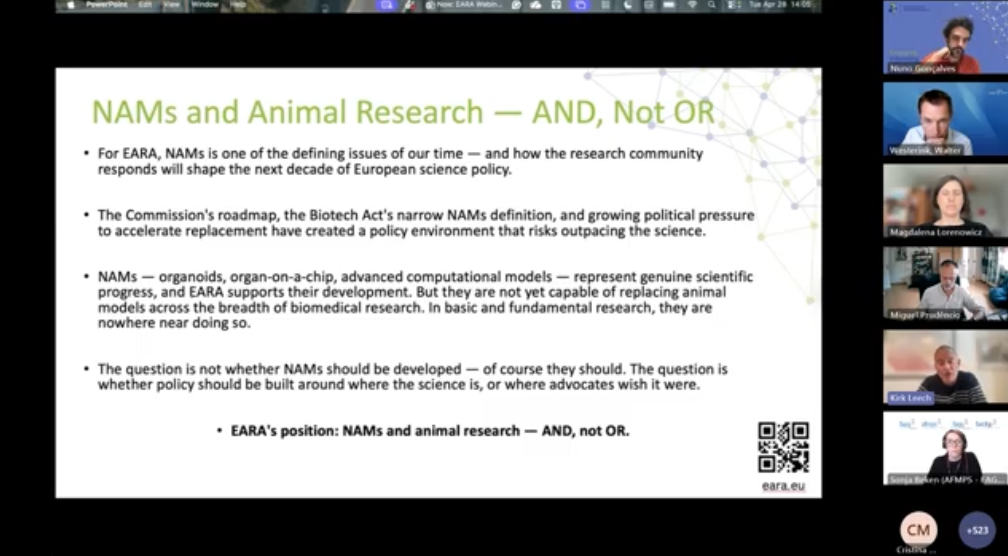
EARA's third webinar in our 2026 series, Animal Research versus NAMs? An Inaccurate Narrative for Scientific Progress, held on 28 April 2026, brought together close to 800 attendees and speakers from academia, industry and regulation to explore how new approach methodologies (NAMs) and animal research can work together in biomedical science. The online session featured contributions from the Netherlands, Portugal, Belgium and the UK, with the intention of moving beyond the idea of an “either/or” choice between NAMs and animal studies and instead focusing on how different approaches can complement each other.
Opening the webinar, Kirk Leech, EARA Executive Director, set out EARA’s position on this politically charged issue, arguing that the central question is not if NAMs should be developed, but that “policy should be built around where the science is, not where advocates wish it were”, adding that “patients need the full toolkit”, meaning all valid scientific methodologies. He also warned that growing political pressure to accelerate replacement is overtaking scientific evidence, particularly in basic and fundamental research, where many NAMs are “nowhere near” replacing animal models.
From EARA Member the Biomedical Primate Research Centre (BPRC) in the Netherlands, Magdalena Lorenowicz described how her team combines non-human primate (NHP) studies, in vitro systemsand computational models to investigate diseases such as long COVID and neurodegeneration. She explained that preserved tissues from COVID-19 vaccine studies now allow researchers to explore long-term consequences of infection, while emphasising the continued importance of animal models such as nonhuman primates in this area, saying: “We can access the tissues that are very difficult or impossible in humans, and that’s what makes this model quite precious.” Her presentation showed how macaque-derived material can be used alongside human in vitro cultures to compare disease mechanisms across species and improve translation to human biology.
Miguel Prudêncio, from the Gulbenkian Institute for Molecular Medicine, also an EARA Member, then focused on malaria and the challenges of infectious disease research. He argued that some questions can be addressed in vitro, especially in early drug screening, but stressed that animal models remain indispensable when studying vaccines and host–pathogen interactions. As he put it, “animal models provide a unique opportunity to investigate vaccines”, because researchers need access to the organs where those immune cells are produced and act, something he described as “very limited and very difficult to do in human subjects”. He illustrated this with his team’s malaria vaccine work and with studies of co-infection between malaria parasites and Epstein–Barr virus, where only an animal model can provide the timing, tissue access and biological control needed to understand how the two infections interact in the same body.
From EARA Member Charles River Laboratories in the Netherlands, Walter Westerink brought an industry perspective, showing how they combine computational, in vitro and in vivo approaches depending on the question at hand. Using skin sensitisation as a case study, he showed that NAMs can already provide robust answers for many compounds, but that animal testing is still needed for poorly soluble substances or chemicals outside the applicability domain of current assays: “Using NAMs for safety testing isn’t just a one-to-one replacement. It really requires a transformation of how we do science”, underlining that the future of safety assessment lies in “smart integration”, not in assuming that any single NAM can automatically replace an animal test.
The regulatory perspective came from Sonja Beken, Coordinator of Non-Clinical Evaluators at Belgium’s Federal Agency for Medicines and Health Products and Chair of the European Medicines Agency’s (EMA) 3Rs Working Party. She outlined how the EMA defines NAMs and what regulatory acceptance actually means in practice. Beken stressed that context of use is decisive, because evidence requirements differ greatly depending on whether a method is being used for safety testing or as part of a broader efficacy evaluation. She also made clear that one-to-one replacement is “rather the exception than the rule”, and that the path to regulatory acceptance depends on scientific robustness, reliability and a clearly defined use case.
Moderated by EARA Deputy Director Nuno Miguel Gonçalves, the panel discussion expanded on the talks and tackled the definitional, scientific and political tensions around NAMs more directly. Returning to the issue of terminology, Kirk Leech argued that “the core problem is that NAMs have become just as much a kind of political term as a scientific one”. When asked whether growing pressure to replace animal use is being felt in institutions working with non-human primates, Magdalena Lorenowicz said that it is “definitely there” and warned against pushing animal models aside simply because new technologies are emerging, adding that “every model needs to be very carefully designed for the questions you need to answer”.
The discussion also returned to the limits of current NAMs for complex biology, with Miguel Prudêncio noting that some infectious disease questions can indeed be studied without animals, but argued that others involve interactions between organs, cells and pathogens that are “not replicable in an in vitro system, at least not for the foreseeable future”. Sonja Beken, by contrast, urged participants to focus less on labels and more on scientific fit, asking, “shouldn’t we be discussing what is the best scientific way to approach a question”, and also whether innovative tools can answer part of it before animal or human studies complete the picture. Taken together, the panel reinforced the webinar’s central message: NAMs and animal research should not be framed as rivals, but as complementary parts of a broader scientific toolkit.
The edited recording is available on EARA’s YouTube channel, and the discussion will also feed into this year’s EARA social media campaign, Be Open About Animal Research Day (#BOARD26), which will focus on the message that NAMs and animal studies are “not a competition, but a collaboration”.