
EARA members in Canada were featured in ‘Découverte’, a French Radio-Canada science documentary series, in an episode addressing animal research, demonstrating Canada’s openness about the use of animals in biomedical research.
The documentary, and companion article, gave an overview of how public and private institutions in Quebéc are working to understand and develop treatments for diseases and the crucial roles of animals and new approach methodologies (NAMs), such as organoids and organs-on-chip, in this process. and organs-on-chip, in this process.
At the Institut national de la recherche scientifique (INRS), an EARA member, director of the animal facilities Julie Arcand showed how rodents are housed and cared for and shared how animal health and welfare is a priority, highlighting how animal research is carefully regulated in Canada by the Canadian Council on Animal Care (CCAC).
Sébastien Tremblay, neuroscientist at Université Laval, also an EARA member, shared that animal welfare oversight is not only crucial for the wellbeing of the animals, but for the research itself. “A stressed animal is not a good research animal. So, from a scientific point of view, it's also in our best interest to ensure that animal welfare is respected.” Tremblay works with macaques to study neurological diseases, stating: “The macaque has a physiology, anatomy, and behavior very similar to those of humans, which means that if something works in macaques, it will very, very likely also work in humans.”
At EARA member Charles River Laboratories, Aurore Varela, Principal Director of Toxicology, explained how animals are essential to test new drugs before they reach humans, to understand potential effects on a whole organism, acknowledging limitations in research models in general: “These [animal] models are not perfect, but they are the best we have today.”
The series also addressed the political pressure to reduce or halt research using animals, highlighting the importance of institutional openness. Lucie Côté, from the Research Institute of the McGill University Health Centre (RI-MUHC) and Director of the Canadian Association for Laboratory Animal Medicine (CALAM), both EARA members, highlighted how institutions in Canada are launching a Transparency Agreement, following Europe’s example, saying: “By signing this transparency agreement, an institution pledges that it is committed to doing more to explain the work with animals and why it is still necessary.”
RI-MUHC researcher Lorenzo Ferri shared his work using new approach methodologies, namely organs-on-chip with cells from patients, to identify personalised treatments for people with esophageal cancer. However, for certain tumours, this approach is still not possible, and his team needs to use mice, showcasing the complementarity between both methodologies.
“We're not at the point where we can say: within two years, we'll replace all animals in research. That would have an impact on people's safety,” said Lucie Côté.
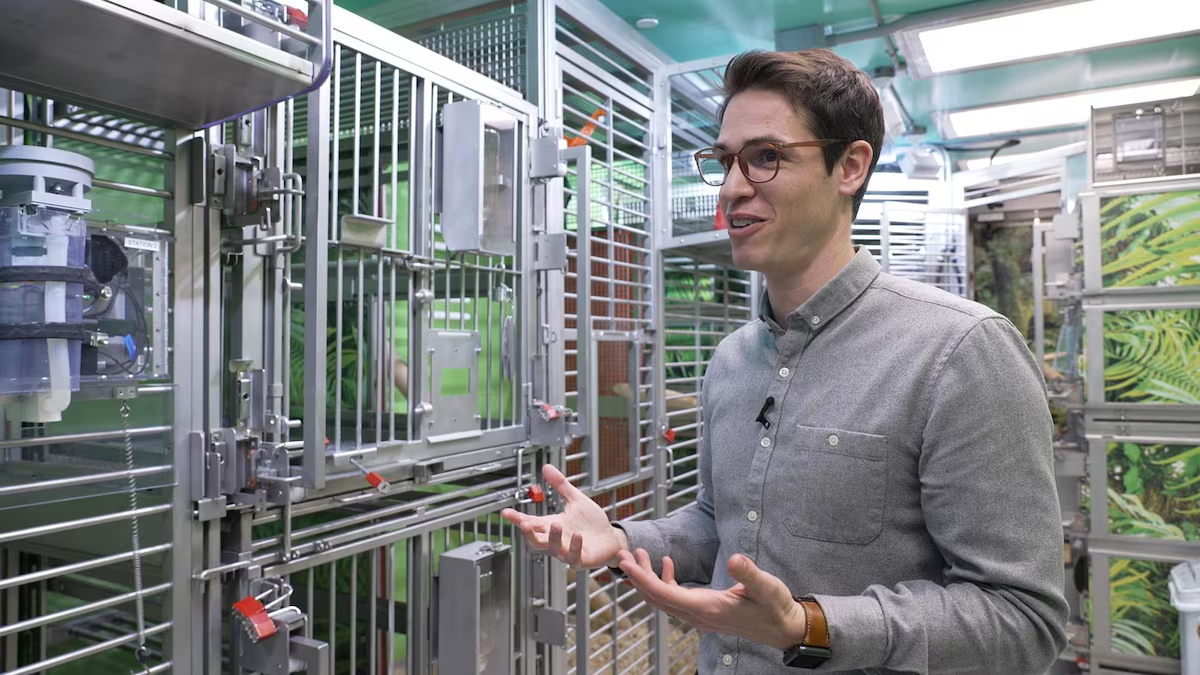
Sébastien Tremblay, neurosciences researcher at the University Laval. CREDITS: RADIO-CANADA / DÃCOUVERTE