
Research in the US found that monkeys become more cautious about potentially contaminated food after a viral outbreak, suggesting that disease exposure can shape how primates protect themselves against infection.
Avoiding potential sources of infection is an important defence against disease. In humans, feelings of disgust towards contaminated food or waste can help prevent exposure to harmful microorganisms. However, researchers still know relatively little about how disease outbreaks or early-life events influence similar behaviours in other primates.
Researchers at the University of California San Diego (UCSD), CA, studied 55 Japanese macaques living at a primate sanctuary in Texas, where three groups had experienced an outbreak of simian retrovirus, which can cause severe illness and weaken the immune system. A fourth group had not been exposed. The monkeys were offered food on either a clean surface or one covered with macaque faeces sealed beneath a transparent protective layer, preserving the appearance of contamination without any infection risk.
Monkeys from outbreak-exposed groups ate from the apparently contaminated surface in 47% of trials, compared with 79% among unexposed monkeys. Their behaviour was similar whether they had personally been infected or not, suggesting that witnessing an outbreak alone could influence avoidance. Moreover, the virus spread mainly through bites and scratches, not contaminated food, suggesting that experiencing disease may increase general caution even toward unrelated risks.
In a separate part of the study involving 54 macaques from seven species coming from different environments, the researchers found that former pets raised by humans were more likely to eat apparently contaminated food than monkeys raised by their mothers in a monkey sanctuary.
Stephan Kaufhold, from UCSD and first author of the study published in Royal Society Open Science, said: “Living through the disease outbreak appears to have made those monkey groups more cautious around food that looks contaminated.”
Future studies could investigate whether newly introduced monkeys adopt the same caution after joining groups that experienced an outbreak.
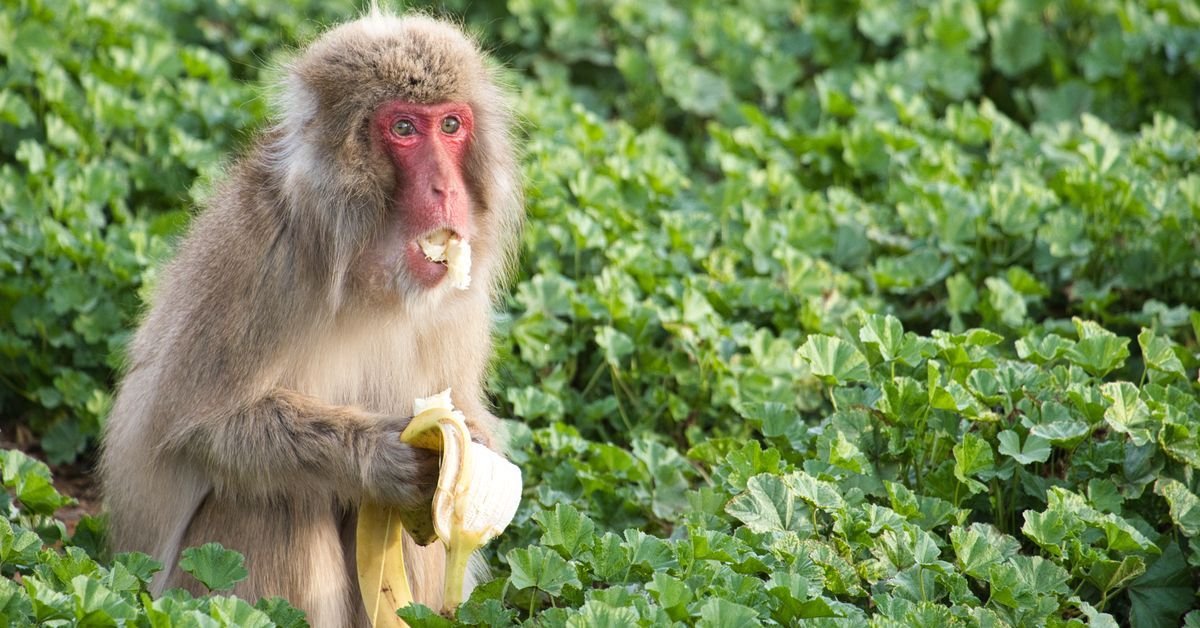
A Japanese macaque eats a banana. CREDIT: UC San Diego.