
A study from Israel has mapped, with unprecedented detail, active genes in different liver regions across several mammals, providing insights into exclusive human biology and disease susceptibility.
Researchers from the Weizmann Institute of Science attained liver samples from eight healthy people who donated a part of their liver to people in need of transplants, possible due to the liver’s regeneration capacity.
They used advanced microscopy techniques to map the activity of genes in each cell across different regions of the liver. For decades, the liver has been thought to be divided into three functional regions, but the new atlas has now found eight regions with distinctive roles.
By comparing humans with laboratory mice, wild pigs and farm cows using the same techniques, the researchers discovered that the human liver has some particularities. In all mammals, the liver is organised into subdivisions, called lobules, and blood circulation delivers nutrients and oxygen from the periphery to the centre or ‘core’.
But the researchers observed that the core was more active in humans, as opposed to the other mammals, together with differences in immune cells. "We found that in humans, unlike in other mammals, a particular type of immune cell prefers to reside in the core of the lobule rather than guarding its periphery — the entry point of blood into the tissue,” shared Oran Yakubovsky, researcher at Weizmann.
The researchers also identified genes specifically altered in cells that showed early symptoms of fatty liver disease, the most common liver disease in Western countries. "Based on the precise mapping of the liver, it may become possible to develop treatments that will target the genes responsible for making specific regions particularly vulnerable to certain diseases," added Shalev Itzkovitz, leader of the study published in Nature.
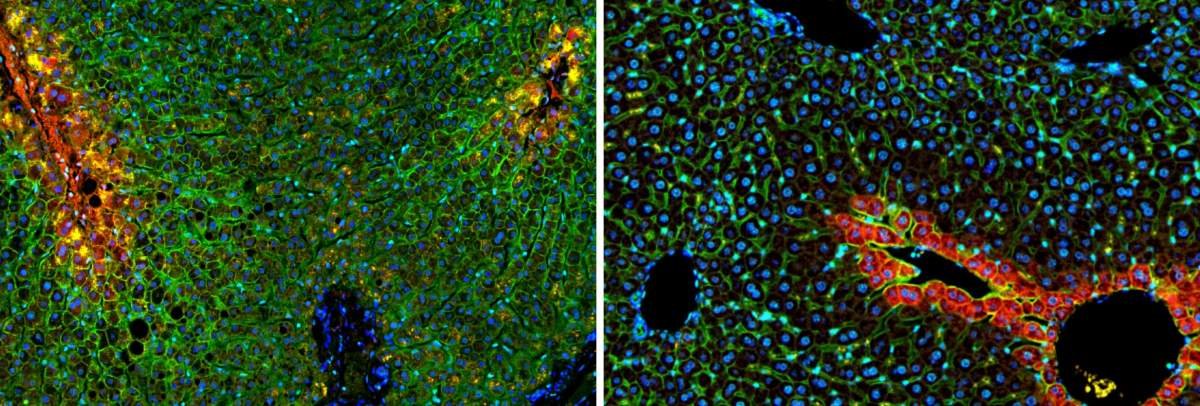
CREDITS: Itzkovitzâs Lab, Weizmann Institute of ScienceÂ